
Lost for Anglicans

Lost is over. This is what it was about:

Without appealing to the trappings of organised religion, Lost dealt – albeit less than coherently  – with good, evil, sin, redemption and the immortality of the human spirit; so it could legitimately claim to be “spiritual, not religious”, the title, coincidentally, of a conference sponsored by the Diocese of New Westminster:

Our keynote speakers understand the spiritual and religious culture of this region in a way that few people do. It is an example of the bridge building that this group is talking about. The book Cascadia explains how we are a distinctive bio-region and the argument in the book is that it is the geography – the mountains, the fish, the rivers, the continental divide – that has created who we are and has helped shape us spiritually. We are different here, largely to do with the fact that we are at the end of the continent and we have this amazing geography.

It looks suspiciously as if the writers of Lost may have drawn inspiration from the meanderings of this obscure and largely defunct corner of dessicated Canadian Anglicanism: Lost was also about a distinctive bio-region, an island, and the effect that it had on those who lived on it. Lost was not specifically Christian – although one could argue that it had a firmer grip on the human condition than the Diocese of New Westminster, since it acknowledged the reality of sin.

Over time, Western Anglican Christianity has become more preoccupied with spirituality, mystery and arcane ritual, and less with truth; consequently you find a speaker at the conference sponsored by the Diocese of New Westminster saying,

“In South American shamanic ayahuasca ceremonies I’ve surrendered to the pulsing heart of the green world and immersed in Jewish Sabbath and high holy days gatherings with friends. I’ve probably taken too many workshops on a wide array of psycho-spiritual and body-oriented healing arts. Some people might say I’ve eaten too many vegetables! My root-meditation practice is inspired by the Buddhist tradition. For 45 minutes each morning I sit and breathe in loving-kindness, a focusing practice that strengthens the heart’s innate capacity to open, accept and forgive.”

This has descended from mystery to muddle – where it cavorts with the spirituality of Lost in which, had you watched it, you would have discovered:

  • The island has a “heart” of light kept glowing by a stone cork plugging a hole;
  • Human guardians of the island live thousands of years after drinking anything – from wine to muddy water – given to them by a previous guardian;
  • A man who fell down the corked hole can – and does – turn into a plume of smoke at will;
  • Electromagnetism from the corked hole is lethal to humans – apart from one;
  • A sequence of doomsday numbers keeps reappearing: their significance is never adequately explained;
  • The island can move through time when an antique wheel is turned.

This goes on and on and none of it makes much sense, scientifically or metaphysically.

Of course, Lost, unlike the Diocese of New Westminster, isn’t pretending to be a church and endless unanswered mysteries (well, some were answered) are good for ratings; moreover, Lost has accomplished what it set out to do: make lots of money for everyone involved – it has been a resounding success. It even entertained a few people along the way – something the Anglican Church has never been able to manage.
The Anglican Church of Canada in the bosom of Mother Earth

Well, the armpit, at least. In the “News From our Partners” section of its web site, the Anglican Church of Canada has a pointer – actually, like so much else in the ACoC, the pointer is screwed up – to a document called Cochabamba – Universal Declaration of the Rights of Mother Earth. In it you will find a Declaration of the Rights of Mother Earth, including:

Article 1. Mother Earth
(1) Mother Earth is a living being.
(2) Mother Earth is a unique, indivisible, self-regulating community of interrelated beings that sustains, contains and reproduces all beings.
(3) Each being is defined by its relationships as an integral part of Mother Earth……

Article 2. Inherent Rights of Mother Earth
(1) Mother Earth and all beings of which she is composed have the following inherent rights:
(a) the right to life and to exist;
(b) the right to be respected;
(c) the right to regenerate its bio-capacity and to continue its vital cycles and processes free from human disruptions;
(d) the right to maintain its identity and integrity as a distinct, self-regulating and interrelated being…….

Article 3. Obligations of human beings to Mother Earth
(1) Every human being is responsible for respecting and living in harmony with Mother Earth…..
(d) ensure that the pursuit of human wellbeing contributes to the wellbeing of Mother Earth, now and in the future;

The ACoC is a member church of Kairos, the organisation peddling this twaddle; I was surprised not to see “I am Fred Hiltz and I approve this message” at the end of the document.

The Anglican Church of Canada wants to have its cake and eat it

Rev. Michael Thompson from St. Jude’s in Oakville has written a rebuttal to an earlier article in the Journal which plainly stated that, if the ACoC is honest, it cannot sign the Anglican Covenant and continue its present course.

Such stark Kierkegaardian either/or propositions tend not to sit well with Western Anglicans; they much prefer interminable Hegelian dialectic garnished with Rowanesque waffle-sauce. Rev. Michael is no exception. Unfortunately, he also seems to inhabit an insular suburban world that has little access to news outside Oakville; he hasn’t noticed that the vast majority of the Anglican Communion are seriously considering – many already have – breaking communion with the ACoC and TEC whether the ACoC likes it or not. The whole article is below, but to summarise, Rev. Michael is saying that the ACoC can sign the covenant, go its merry way, hide behind the ludicrous canard that it is contributing to “diversity”, ignore the protests of 70 million Anglicans – whose priests are wicked interventionists anyway – and pretend everything is just fine. The truly grotesque thing is, he appears to believe it.

In the work that bears his name, Gilbert and Sullivan’s wonderfully imagined Mikado purports “To let the punishment fit the crime, the punishment fit the crime.” In their guest opinion column in the Anglican Journal (May 2010, p. 5), Catherine Sider-Hamilton and Dean Mercer have, on the other hand, already decided the punishment– “a second-tier status in the larger Anglican Communion.” It remains only to conjure up the requisite crime.

Their opening gambit is to accuse our church of a “willingness to walk apart from the universal church.” Never mind the long list of Canadian Anglicans who have served and are now serving the life of the Communion. The Anglican Indigenous Network (Donna Bomberry), The Compass Rose Society (Bishop Philip Poole), Theological Education for the Anglican Communion (Archbishop Colin Johnson), the Anglican Covenant Working Group (Dr. Eileen Scully) and Unity, Faith and Order (Alyson Barnett-Cowan) don’t count. And never mind those bishops who have abandoned almost 2,000 years of Catholic ecclesiology to interfere with the integrity of the local church in this and other provinces because they and they alone know how to receive and interpret God’s word revealed in scripture.

In 2004, General Synod heard both the Chaplain to the Archbishop of Canterbury, Gregory Cameron, and the Bishop of Colombo, Duleep de Chickera. While Canon Cameron counseled caution, Bishop Duleep reminded us that not all voices in the wider Communion spoke as one and encouraged Canadian Anglicans to cherish our contributions to Anglican diversity. In 2007, the General Synod heard both Archbishop of York, John Sentamu and General Secretary of the Anglican Communion, Kenneth Kearon. Last year, Canon Isaac Kawuki-Mukasa of the Faith, Worship and Ministry Department of General Synod established personal contact among bishops and theologians in Canada and Africa, including a February gathering of Canadian and African bishops to build respect and mutual understanding. This is not a church as unable to embrace “a primary commitment to the universal and apostolic church” or as inimical to “the wider voice of the church.”

Next, the writers imply that the current conflict pits those who love and faithfully receive scripture against those who despise it, who find its teaching “oppressive and outdated.” But we know that those who support the blessing of committed monogamous same-sex relationships include many who know and love the Bible as living witness to the living God. And we know that as we receive and interpret scripture, the truth that emerges is often contested truth–as for example, we come to divergent conclusions about the response that the God revealed in scripture invites to a question of sexual ethics and Kingdom ethos in the 21st century. Conflict and contested truth are not unfamiliar to Jesus’ disciples, and need not tear apart the foundational covenant of our common baptism into one body. We could renew a healthier and more faithful discourse by acknowledging contested truth and engaging in honest and charitable conversation about the practices, values and contextual realities that shape our reception and interpretation of scripture.

In the communiqué issued from their 2000 meeting in Portugal, the Primates of the Anglican Communion said this:

We are conscious that we all stand together at the foot of the Cross of Jesus Christ, so we know that to turn away from each other would be to turn away from the Cross.

They went on to draw a bright line distinction as the only basis for a province or diocese being excluded from the Communion:

…the unity of the Communion as a whole still rests on the Lambeth Quadrilateral: the Holy Scriptures as the rule and standard of faith; the creeds of the undivided Church; the two Sacraments ordained by Christ himself and the historic episcopate. Only a formal and public repudiation of this would place a diocese or Province outside the Anglican Communion.

The Anglican Church of Canada has not turned away, either from those provinces whose leadership is visibly, even angrily, distressed by the divergence apparent in the current conflict, or from the Lambeth Quadrilateral. And we have not turned away from those among us whose lives of commitment we experience as vessels of God’s blessing.

Ms. Sider-Hamilton and Mr. Mercer argue that if we won’t turn away from those among us whose lives of intimate fidelity are shared with a person of the same sex, we must turn away from covenant revelation with those with whom we disagree on this singular issue. But in the Anglican Church of Canada, we turn away, not from covenant relationship, but from the sin that binds and blinds us, from the structures that impair justice and right relationship, and from the Adversary who resists the inbreaking kingdom of God. And as we turn to Jesus, we find him standing in the midst of the very community one part of which Mr. Mercer and Ms Sider-Hamilton insist we must abandon. There Jesus stands, in a community of divergent truths, worried suspicion, and fear, and begs us not to turn away from any of his sisters and brothers, but to accept the unity he offers up out of his own breath and blood.

One wonders why Thompson even wants the ACoC to sign the Covenant; it couldn’t be because the ACoC enjoys temporal power too much to be willing to let it go for its principles, could it? Surely not.

The Anglican Covenant at the Canadian GS2010

The ACoC has a document to help attendees prepare for the General Synod 2010 discussion – or waffle – on the Anglican Covenant. Read it all here. Section 4 of the Covenant is the potentially contentious part, since it seeks to reign in Provinces such as TEC and the ACoC that have decided to go their own way on issues like same-sex blessings. Conservatives complain that section 4 has no teeth and liberals that it interferes with matters that are internal to a Province. It has no teeth.

In Section Four, affirmations and commitments are offered relating to processes and principles that should be followed in situations of conflict between provinces. The particular issues of potential or present conflict are not named, and the processes laid out work within the present structures of the Anglican Consultative Council, with the standing committee of that council serving as the mediating agent. The standing committee’s power is only to recommend courses of relational consequences to the council’s own constitutionally formed processes.

Member churches of the Anglican Consultative Council are invited to enter into this covenanted relationship, which makes tangible affirmations and commitments about our common heritage, participation in God’s mission, and mutual responsibility in the bonds of affection. When a situation of conflict arises, churches are enjoined to seek the mind of Christ, and the affirmations and commitments in Sections One, Two and Three provide tools for discerning dialogue. The possible outcomes cannot be predicted. Common mind may include, for example, the agreement to disagree on a particular issue, but to keep walking together. What is clear is that Section Four does not supplant the existing authorities, the canons and constitutions of provinces, or the constitution of the Anglican Consultative Council.

So to summarise the document’s preparation for discussing section 4:

  • If a Province breaks the Covenant, the consequences are “relational” resulting, no doubt, in a severe scolding.
  • If there is disagreement after signing the Covenant we’ll have some “discerning dialogue”. TEC and the ACoC have had a lot of practise at this: each could single-handedly bore the balls off a buffalo, let alone shrivel the resolve of all but the most hardy opposition.
  • If TEC and the ACoC fail to subdue the enemy by focussed, concentrated magniloquence, then the “common mind” simply changes its meaning to “we disagree”. Black is white, up is down, and so begins another normal day in the ACoC.
  • Who cares anyway because section 4 has no teeth.

The Anglican Church of Canada is a laughingstock

Even in Texas:

Ridiculously  False Statement

Tom, of Boomers fame, sent me this quote from Mark Steyn:

“Most mainline Protestant churches are, to one degree or another, post-Christian. If they no longer seem disposed to converting the unbelieving to Christ, they can at least convert them to the boggiest of soft-left clichés, on the grounds that if Jesus were alive today he’d most likely be a gay Anglican bishop in a committed relationship driving around in an environmentally friendly car with an “Arms are for Hugging” sticker on the way to an interfaith dialogue with a Wiccan and a couple of Wahhabi imams.”

There is absolutely no truth, whatsoever, in Mr. Steyn’s absurd analysis of Ms. Jefferts Schori’s thriving Episcopal Church and its tiny cousin, the ACoC (Anglican Church of Canada).

How cruel.

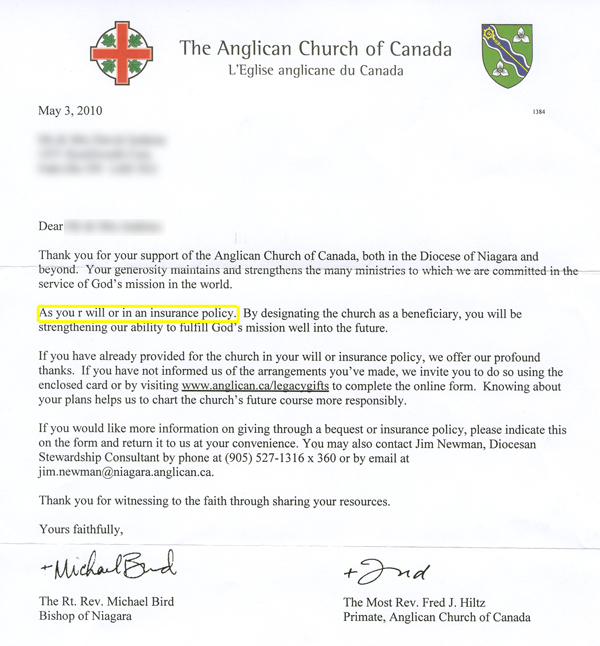
The Anglican Church of Canada wants your money when you die

Mike and Fred even sent me a letter – presumably in the hope that I sink into advanced dementia before joining the choir invisible – asking to be remembered in my will.

The first sentence of the second paragraph had obviously been partially deleted; one presumes the ACoC can’t afford a proofreader until someone else dies.

I had assumed it should have read something like this:

As you reflect on your contributions to the church, we encourage you to consider including your parish or diocese in your will or in an insurance policy. By designating the church as a beneficiary, you will be strengthening our ability to fulfil God’s mission by continuing to sue ANiC parishes.

But apparently not; according to the Niagara web site the last part of the sentence should read…. “fulfill God’s mission well into the future”. I expect Fred made Mike change that bit.

Congratulations Bishop Victoria Matthews

I had no idea that Bishop Victoria Matthews had made life difficult for Michael Ingham; thank you, Bishop Victoria, you and your irenic presence are now on my Christmas card list.

Bishop Matthews previously served in the Anglican Church of Canada. Anyone familiar with how difficult she made life for Bishop Michael Ingham after he and the Diocese of New Westminster approved the blessing of same sex relationships will have a hard time accepting her self portrait as an irenic presence.

Toronto gay pride denied federal funds

Apparently, taxpayers are not going have to pay to celebrate sodomy this year; shame, since it provides such a wonderful opportunity for a wholesome family outing:

Organizers of Toronto’s gay pride festival were surprised and angry Friday at the Conservative government’s decision to drop the Add   an Imagelucrative and popular event from its tourism stimulus package.

Pride Toronto was not on the list of over 50 festivals awarded grants on Friday as part of the federal government’s two-year, $100-million Marquee Tourism program.

In a statement Friday, Industry Minister Tony Clement said there are 20 new beneficiaries this year, and the fund’s second-year goal was to “ensure regional fairness by making sure every corner of Canada benefits from this temporary stimulus program.

Pride Toronto executive director Tracey Sandilands called the decision a “clear indication that the federal government doesn’t believe that queer arts and culture is worth investment in.”

“We are very disappointed …. We believe that that is a very strong message for the queer community, especially here in Toronto,”

Add an Image

Sandilands told the CBC’s Rosemary Barton.

Not to worry, the parade will still have plenty of support from the usual mob.


Fred Hiltz calls for justice at the G8; luckily no-one is listening

Not justice for the unborn, of course, he is leaving that to Stephen Harper; the deliberate slaughter of babies seems to be of little interest to Hiltz and his abortion-happy breed of Canadian faux-Anglicans. Instead, Fred is getting together with a like-minded assortment of shamans, misfits and verbally incontinent leftists to badger the G8 nations into adopting the idiotic Millennium Development Goals. The MDGs are quixotic and self-defeating: they can never be achieved; the call to meet them will be endlessly renewed; their failure is always blamed on Western governments and, best of all, they divert attention away from the theological, financial and spiritual bankruptcy of those doing the calling. This all suits Fred to a tee.

Archbishop Hiltz, who has made the MDGs a hallmark of his primacy, has been chosen to lead the Canadian interfaith delegation.

At the Winnipeg summit, leaders from 10 different faith traditions-including Muslim, Christian and Shinto-will listen to and report to one another about important issues in their nations. They will hear several high-profile speakers including Canadian senator Romeo Dallaire; the Rev. Jim Wallis of Sojourners magazine, USA; and H.E. Sheikh Shaban Mubajje, grand mufti of Uganda.

The Anglican Church of Canada is not obsessed with sex. At all.

Particularly not homosexual sex.

As Bishop John Chapman says:

It may be a hot-button topic in the mainstream media but the issue of human sexuality – including homosexuality – hardly saw the light of day at the gathering in England Feb. 24-26 of six African bishops and five Canadian bishops, including Bishop John Chapman. “We had an initial conversation on human sexuality on the first evening together and that was the last time we talked about it,” said the bishop in a recent Crosstalk interview.

It’s true that Bishop Michael Ingham has a web site dedicated to the subject and John Chapman hit the headlines of the Ottawa Citizen – but that was just a media plot to make him look as if he thinks about little else. The Anglican Church of Canada has a similar problem; this extensive Wikipedia article is clearly part of the same plot.

To show how far the enemies of the ACoC are prepared to go to make it look ridiculous, here is a remarkably lifelike simulacrum of Fred Hiltz describing how he went all the way to the UK to discuss unnatural sex with Rowan Williams. In spite of the patent absurdity of this hoax, it presents conclusive evidence that the concocters of this devious conspiracy have reached a worrying level of technical sophistication. You can see from this video that the counterfeit is almost as dull as the real thing; an astonishing achievement.