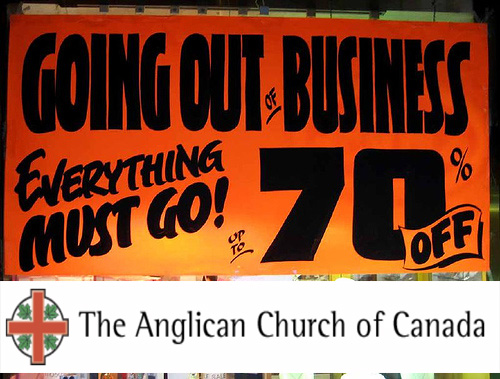
Anglican clergyman is reluctant to define Anglicanism

From here:

The prospect of something codified and named Anglicanism I find unsettling. Roman Catholicism provides an ecclesial authoritarian structure and demands subservient obedience from its adherents. Protestantism provides several forms of confessional authoritarianism, requiring subservience to refined interpretations of scripture and doctrine. Biblical Fundamentalism, of course, comes across as absolutely absolute in its biblical interpretations, that is, according to whomever the pastor or preacher may be. What is disturbing is the concept of subservience to humanly contrived authorities that seem to me to be the antithesis of the liberation and freedom that is the gospel (good news) of God’s redemption through Jesus Christ who we know as Saviour and Lord.

This comes as no surprise, since once you codify – systematise or define – what Anglicanism is, you also define  what it isn’t; and that would exclude many Western Anglicans: to be Anglican requires a person at least to be a Christian.

Canon Gordon Baker seems to think that the Bible is a human contrivance and is disturbed by those who think it isn’t. Although he claims to know Jesus as Saviour and Lord, I can’t help wondering where his knowledge comes from since he doesn’t accept Biblical accounts as fundamental and absolute.

The truth is, his “liberation” is the familiar antinomian bad news of “if it feels good, do it”.

The Anglican Church of Canada desperately seeking cash

The ACoC is running out of money, so it is giving the Health and Wealth gospel a shot; being effete liberal elitists, their stewardship mavens call it a theology of abundance, though:

“This is stewardship, not fundraising” is something I have heard often during the past 15 years as a stewardship teacher. However, as a once-upon-a-time development director for a most-worthy-cause non-profit organization, I know that large gifts always have a spiritual component….

That being said, the Symposium on the Spirituality of Philanthropy presented by the Office of Mission Funding of the Episcopal Church in late September was a first, and frankly long overdue. The 64 participants, representing 31 dioceses and eight provinces of the Episcopal Church, as well as the Anglican Church of Canada, filled the Episcopal Church Center’s chapel to hear four presentations that combined the theology of abundance with highly practical approaches to making the “ask” for a major gift.

Aborted babies being left to die

From here:

BABIES that are surviving late-term abortions at Melbourne’s Royal Women’s Hospital might be being left on shelves to die, according to an Anglican minister.

Dr Mark Durie, minister of St Mary’s Caulfield, said staff were finding it hard to cope with a reported six-fold increase in late-term abortions at the Women’s since abortion was decriminalised in Victoria two years ago. He said because conscientious objection by medical staff was now illegal, the hospital could employ only people who endorsed late-term abortions.

Dr Durie is bringing a motion about late-term abortion to the annual Anglican synod, which opened in Melbourne last night.

He calls on the state government to answer five questions about late-term abortions:

■ How many are happening, and how late?

■ What are the reasons for the abortions?

■ Are those born alive receiving medical care, or what is their cause of death?

■ What has been the effect on staff morale at the Royal Women’s Hospital?

■ What has been the effect on staff recruitment?

He said in one case – not at the Women’s – a trainee was deeply traumatised when she was told to drop a living foetus in a bucket of formaldehyde.

The Anglican diocese of Melbourne backed decriminalising abortion in its submission to the Victorian Law Reform Commission review in 2007. Archdeacon Alison Taylor told The Age at the time that in some circumstances, such as foetal abnormality, abortion was the ”the least problematic solution”.

The Anglican diocese of Melbourne was, predictably, on the wrong side of this issue; let’s hope that that changes.

Abortion in Canada has been legal and unrestricted since 1988. In spite of its pretensions to speak on social justice matters with a “prophetic voice”, the Anglican Church of Canada continues to maintain a mealy-mouthed silence about abortion, including late-term abortion and the fate of aborted babies that survive – until being dropped into formaldehyde.

What does the Anglican Church stand for?

A question posed by The Rev. Dr. Gary Nicolosi here:

Did you know that more people around the world can identify the golden arches of McDonald’s than the cross of Jesus Christ?

Why is that?

Ask any bystander what the Anglican Church of Canada stands for and you will probably get a blank stare.

If it comes to that, ask any Anglican and you will probably get a blank stare. The Anglican Church of Canada has gone to great pains not to stand unequivocally for the foundational beliefs of the faith for which it thinks it is a merchant. Bishops and priests routinely dither on questions of Jesus’ divinity, his atoning sacrifice on the cross, his bodily resurrection and man’s innate sinfulness. Many priests say that they cannot, in good conscience, recite the creeds and some no longer hold with antiquated ideas such as heaven and hell.

Perhaps that is why.

Archbishop Douglas Hambidge is astounded

It doesn’t take much to astound him, though, according to this letter to the Anglican Journal:

As a former member of the Anglican Consultative Council and of its standing committee, I am astounded to learn the standing committee actually voted on whether or not to dismiss The Episcopal Church from the Anglican Communion. I wonder where it imagines it has the authority to do this.

The Anglican Consultative Council, and obviously its standing committee, does not have legislative authority. It is, by definition, consultative, as is the Lambeth Conference and the meeting of Primates. That is the nature of the church.

We do not have a central supreme authority; we do not have a Curia. We have disagreements, but what binds us together is greater than things that could drive us apart. We do not always get our own way in debate; not everyone agrees with everyone else. We are not that kind of church.

What we do have is a community held together not by laws and government, but by those “bonds of affection” that have always been the basis of Anglicanism.

Archbishop Douglas Hambidge
Delta, B.C.

When Archbishop Hambidge intones, “[w]e do not have a central supreme authority”, he is not far from the mark. The Anglican Church of Canada recognises no central authority, including God’s as revealed in his Word. Instead it wafts along blown hither and thither by every gust of pagan superstition and cultural vice it encounters.

The “bonds of affection” between Anglicans has long gone, with the vast majority of worldwide Anglicans having declared themselves in impaired communion with both the ACoC and TEC. This probably doesn’t impinge much on Archbishop Hambidge’s equanimity, ensconced as he is in the insular, increasingly insignificant, neo-colonial, North American oddity that thinks it represents Anglican Christians in the West.

The Age of Aquarius dawns in Christ Anglican Church, London

I went to see Hair in London, UK in the 1960s. I wasn’t a Christian in those days and, while I enjoyed the general aura of comfortably rebellious hairiness, it still struck me as pretentious drivel. Even then I knew enough about Christianity to understand that “The Age of Aquarius” doesn’t belong in a church. Until now, that is; and where would it fit better than in an Anglican Church. Another fine production from Christ Anglican Church London:

I expect next year they will enthral the audience with a rendition of another Hair favourite: “Masturbation Can be Fun” – with actions if we’re really unlucky.

Trinity Anglican Church, Aurora joins with local Muslims

From here:

(Aurora, ON) – A last minute decision was made on Thursday, September 9 by Aurora’s Trinity Anglican Clergy  – The Reverend Canon Dawn Davis, and the Reverends Stephen Kern and Dawn Leger would create a living answer to the threats of burning copies of the Qur’ans made by church members in Florida.

In co-operation with the Trinity Church’s resident Interfaith Minister, Rev. Terry Weller, a theme was decided upon – “The only burning we are interested in is a burning desire for “PEACE, RECONCILIATION AND RESPECT”.

A secondary theme presented was: “OUR GOD CREATED DIVERSITY ON THIS EARTH. WE HOLD THAT THERE IS UNITY IN DIVERSITY”.

While, as Christians, we should live peacefully with our neighbours of other faiths, if the message of the early church to opposing religions had been: “Our god created diversity on this earth. We hold that there is unity in diversity”, there would be no Trinity Anglican Church, Aurora. Perhaps that would not be such a bad thing.

Rev. Canon Douglas Graydon pleads for the excluded

The Rev. Canon Douglas Graydon considers the great Anglican non event of 2010 – General Synod – and writes:

And yet, gay and lesbian Anglicans continue to stand off to the side, relegated to being less than complete human beings within our community of faith. As long as the learning, discerning

prayerful debates or indaba-like conversations continue, gay and lesbian Anglicans will be denied what every other Anglican enjoys: the full and blessed recognition of our relationships.

Let us keep in mind the human dimension of every church debate that involves the “worthiness” of another to receive the recognition and blessing of “the church.” And recognize the suffering experienced by those who are excluded, year after year, decade after decade.

God help us to learn more quickly from our own history of exclusion and to live more boldly Christ’s radical love of inclusion.

Rev. Graydon is one mixed up Canon.

99% of Canadians who freely choose – indeed, who could not be dragged kicking and screaming into an Anglican Church – to “stand off to the side” of Anglicanism would probably be shocked to learn that, by doing so, they are  “less than complete human beings”. For most of humanity, “blessing” resides in the comforting assurance that “decade after decade” they have been absent from an Anglican Church.

Every other Anglican does not enjoy “the full and blessed recognition” of his relationships. My dog and I have a deep, committed but hitherto unblessed relationship; he is hurt and feels profoundly excluded every Sunday when I set off to church without him, although his grief is considerably assuaged by noting the presence of the Anglican Journal in the cat’s litter box.

A blessing from an average Canadian Anglican Church isn’t worth much, so the “worthiness” of its recipient isn’t particularly relevant. In a real church, though, parishioners are acutely aware that they are unworthy of anything at all: any worthiness that has accrued to them is through Christ’s atoning sacrifice on the cross and any blessing an unearned favour, not a “right” to be bludgeoned out of the disintegrating Anglican diabolarchy that masquerades as a church.

The Rev. Canon should try and keep up with the times a little more. The “new gay” is polyamory; when is he going to start campaigning for the egregiously excluded polyamorists? – after all, they suffer so.

The hijacking of the Holy Spirit

I attend an Anglican Church that experienced what, in the 1980s, we called “renewal”. We acknowledged the presence and activity of the third person of the Trinity in worship, practised the gifts of the Holy Spirit and were viewed by the sober apparatchiks of the Diocese of Niagara as loony fundamentalists. We didn’t particularly care, since we ignored the diocese and they ignored us – unless they were running short of cash. All that was to change in 2008 when we joined ANiC – except for the diocese’s voracious appetite for Mammon to pay its lawyers.

But I digress. In the 1980s no respectable Anglican wanted anything to do with the Holy Spirit: his presence brought change, chaos, mayhem and, well, people who knew what they believed and took Christianity seriously – and that will never do in a church that is preoccupied with embracing “uncertainties, our fears, our doubts and the many challenges raised by scientific insights.”

In those halcyon days, any self-respecting bishop was constitutionally incapable of saying “Holy Spirit” – outside of the sterilising setting of liturgy – without having an attack of the vapours. Sadly, those times are gone and now the Canadian bishop does not exist who is not prosecuting some ploddingly dull or extravagantly heretical plan or other at the behest of the “spirit”, using the word as a justifying incantation at every opportunity. That this is a bogus “spirit” goes without saying. After all, the third Person of the Trinity is eternal and of one substance with the Father (come to think of it, Anglican bishops don’t even believe in the Father); the irritatingly ubiquitous phantasma, apparitions, bishops’ familiars are spirits of another kind.

In the worthy missive of the Diocese of New Westminster, we are told that there is only a “Holy Spirit” in order to foster “diversity”. If we could be just a little more diverse of our own accord, this particular spirit – the diversity-coach spirit – would not have been needed and presumably not created (page 2):

Commenting on our life together in the unity of the Spirit, Charleston asked “Why is there a Holy Spirit?” “Because God knew we would never agree and gives us comfort, guidance and wisdom to supply what the human family of God needs in conflict — the ability to live together in our very real diversity.”

The same article tells us that the church has moved from the “Age of Faith” to the “Age of Belief” into the “Age of the Spirit”; indeed it has, but it would be more accurate to say the “Age of the Zeitgeist”.