
The Anglican Consultative Council is doing the Discernment Group Jig in Jamaica

Three years ago the Anglican Church was invited to observe the ponderings of the ACC, but was not allowed to participate because of its wayward determination to bless same-sex couples. The ACC chairman, John Paterson, who obviously sympathises with the ACoC and TEC, indulged in some hand-wringing:

I was saddened personally by what took place at ACC13 in Nottingham. I chaired the session at which a vote was taken to “endorse the Primates’ request that ‘in order to recognise the integrity of all parties, the Episcopal Church (USA) and the Anglican Church of Canada voluntarily withdraw their members from the ACC, for the period leading up to the next Lambeth Conference'”. Your representatives were not permitted to speak or to vote on that resolution. It was carried by two votes. The effect of it was to ostracise the American and Canadian representatives, who were forced to live apart and walk apart.

Now, however, all is forgiven and the ACoC and TEC have been welcomed back into the ACC’s bosom as a reward for behaving themselves and observing the moratorium on same-sex blessings. Apart, in the ACoC’s case, from the dioceses of New Westminster, Montreal, Niagara, Rupert’s Land, Ottawa and Toronto who are observing the moratorium through experientially discerning whether they should observe it by doing what they are not supposed to do. Or something. But the rotters in the Southern Cone are still intervening.

The conference will also consider the report of the Windsor Continuation Group (WCG). While organizers did not say what the delegates would be considering, Canon Kearon said that the report’s view of the three moratoria was that the moratorium on the consent to the consecration of a bishop in a same sex relationship had held, that the moratorium on the public rites of same-sex blessings had held by and large, but that cross-border interventions had not ceased but had gotten worse.

Canada’s lay delegate is delighted to be no longer anathema:

Canadian Anglicans are being greeted with warmth and stated relief that we are here to participate fully, and not suspicion or disgust as we experienced in Nottingham three years ago when we sat as observers)

And is in denial over the ACoC being a ‘problem’ – in a genteel Canadian way, eh:

Personally, said Ms. Lawson, “I have some concerns that I’m going to talk to people about and that is that the bulk of the responsibility for dealing with ‘problems,’ and I think the Canadian church is considered ‘a problem’ – although we don’t think so – [is] in the hands of the majority of primates, bishops and clergy of the Joint Standing Committee, which is being given increasing power….”

The hot topic at ACC14 is the Anglican Covenant which provinces will have to sign if they wish to be in with the Anglican in-crowd. Of course, by the time the Anglican Covenant sees the light of day and the ACoC has dithered over whether to sign it, the only people left in the church will be Marvin the Robot, otherwise unemployable assorted bishops and clergy, and three same-sex couples:

It would be up to two meetings of General Synod, the Anglican Church of Canada’s governing body, to decide whether or not the church should sign on to the covenant, a process that could take at least six years.

The Anglican Church of Canada Theological Commission's paper on Same Sex Hanky-Panky

The Primate’s Theological Commission has produced a new paper; it has taken 2 years to ferment and has now been released at full potency. Anyone wishing to be beguiled by the full brunt of its soporific charm can read it here;  it isn’t very long and the title, “Integrity and Sanctity”, gives the game away. The article itself appears to be little more than a build-up for the main event: a softening up of the audience.

This means that a relationship may have the potential for sanctity, but even a relationship that is specifically ordered toward the sanctification of its members is dependent upon whether or not they actively pursue holiness within that relationship. And since holiness consists in loving God, and loving God consists in doing God’s will, a relationship will be holy only to the extent that its members are doing God’s will.

In short, when we speak of the “integrity of every human person” and “the sanctity of human relationships,” we are speaking not of a quality inherent in ourselves, but of the destiny for which every human person was created – to become who we were made to be in Christ, in conformity to the will of God, by the power of the Holy Spirit.

The quoted paragraphs illustrate the art of Anglican Ambiguity at its most refined: say something that could appeal to anyone. Nevertheless, I think the stage has been set: all that is missing is the paper that announces “God made me the way I am: gayness is a gift”. Once that appears, this paper’s “to become who we were made to be in Christ” will transport us to the finish line: same sex blessings coming to an Anglican church close to you in 2010.

Pollyanna Christianity

A thread on another blog started me thinking about how things could have gone so catastrophically wrong in the Western Anglican church without a large number of people standing up and saying “Enough – stop!”

In Canada, part of the reason is that we want so much to be Nice To Each Other (well, I don’t), so when we disagree we have to affirm people on the other side of the issue and, preferably have a “conversation”, rather than an argument.

A tolerant, liberal drift has infected much of the Western church – to the extent that, when we disagree, it has to be at the level of “I’m OK,you’re OK” even if the truth demands that, if I’m right, you are really far from OK. This uncomfortable situation was incisively illustrated at a synod in the diocese of Niagara. When the issue of same sex blessings was discussed, a number of clergy stated that they could not go along with it because they could not contradict a clear biblical teaching. In the ensuing discussion, it became clear that many clergy were unwilling to admit that, as a Christian, one must at least attempt to adhere to clear biblical teaching. Finally, an astute fellow with a funny collar stood up and said with an air of one suffering a mortal insult: “you are saying that I am not a Christian!” Bingo.

Here, there is a plea for discussion to be conducted in “a positive, life giving way”. What does this mean? If the truth is that the “gate is narrow and the way is hard that leads to life, and those who find it are few”, then surely the positive and life-giving thing to do is to make the case for the “narrow way” as strenuously as possible; even if it means being less than nice.

When it comes to addressing church leaders who are leading their flock away from the narrow gate, I am a Luke 17:2 and Gal 5:12 enthusiast.

The Anglican Church of Canada's Vision 2019

There are some more interesting comments on the ACoC site. Since I appear to be persona non gratis and can’t leave comments there, here are some observations on recent entries:

Frank Wirrell says:

April 6, 2009 at 11:25 pm

The comments with respect to justice sound good but to thank the Primate is definitely stretching the truth. The lack of any justice toward orthodox parishes and Anglicans can only be described as the work of Satan. The writer should carefully examine his statement that we should get past the same-sex issues. That issue is simply the tip of the iceberg and demonstrates a complete rejection of God’s word. So-called bishops, including the Primate, that are prepared to claim they can bless same-sex unions are not only deceiving themselves but are deceiving and misleading those involved. Each of us has a tendency to sin in one area or another and that includes being involved in homosexual activity or adultery. Rather than endorsing any sin we need to honestly repent and not be led down the garden path by political expediency. If the Primate were honestly interested in justice he would order that all actions against orthodox parishes cease and that apostate bishops resign their positions.

The Rev. Daniel Graves says:

April 28, 2009 at 12:05 pm

I find it disheartening that in an exercise that is intended for the building up of the kingdom of God, we continue to see our bishops characterized in such derisive terms. The primate (and our other bishops) are not “so-called” bishops, they are bishops in the Church of God. Similarly, to toss around a term like apostasy is very unhelpful. The elevation of abusive language in these debates is not at all edifying. In my experience, our Primate has never been anything but gracious. His invitation into this discussion and his willingness to listen to all voices has been most gracious. I hope that we as Canadian Anglicans would reciprocate with a similar graciousness that would be characterized in the tone of our language.

Frank Wirrell, Abbotsford, B.C. says:

April 29, 2009 at 4:17 pm

I have noted the response of Fr. Dan Graves and would ask what he finds offensive in my remarks. Clearly the time has come to call a spade a spade. Bishops, clergy and laity that deny the authority of Scripture and attempt to make such authority subject to a majority vote are apostates – politely but mistakenly called liberals. The Primate might well be gracious under some circumstances but his lack of action to deal with apostasy cannot be and should not be overlooked. Certainly he has not been gracious to orthodox Anglicans. To be a true Anglican one must first be a Christian and when you have so-called bishops proclaiming that all religions lead to the same place, action is mandatory to have them repent or remove them from office.

You cannot build a church on sand but only on the Solid Rock. The Anglican Church of Canada is quickly losing its “right” to be called a church of God and needs to repent and turn back from the sin of political expediency.

One of the significant things about this exchange is the fact that the ACoC’s defender is basing his defence on the use of language, rather than truth. The redoubtable Frank is intent upon calling “a spade a spade” and this is what seems to upset Rev. Daniel.

After all, we are Canadian: what matters is being nice to each other, not the truth.

And to set the record straight, the primate, Fred Hiltz is not as gracious as Rev. Daniel would like us to believe: he is supporting dioceses that are suing the pants off people who disagree with them.

Diocese of New Westminster: damage control in a time of disintegration

The diocese of New Westminster has recognised that things are falling apart; their strategic plan whimpers:

Our numbers are declining at an alarming rate, and we have fewer financial resources with which to do mission. Our relevance is called into question.

A surprisingly honest assessment; the diagnosis may be accurate, but how does the diocese plan on reversing the rot?

First, no more money for parishes that can’t support themselves:

The need for a comprehensive diocesan plan has become even more urgent, with the changed economic conditions of the past several months. No longer can parishes in crisis come to diocese standing committees and be assured they will get the financial aid they may need. The money just isn’t there.

One thing we’re asking of all parishes-even before they enter into a Ministry Assessment Process-is that they undertake an honest self-assessment to discern their best future for furthering God’s mission in the world.

Regionally, we see a need for parishes to plan and work together. We are exploring a variety of alternatives to present arrangements together.

The message to parishes: succeed, consolidate or close; don’t expect the diocese to carry you.

In its quest for “relevance”, the diocese proposes – more of the same:

More specifically, Archbishop Fred Hiltz, the Primate of the Anglican Church of Canada, has said we should take our cue from the “Five Marks of Mission” that the whole Anglican Communion has worked out through years of study and prayer. The five marks are: to proclaim the Good News of God’s kingdom; to reach, baptize, and nurture new believers; to respond to human needs by loving service; to seek to transform unjust structure of society; and to strive to safeguard the integrity of creation and sustain and renew the life of the earth.

The only glimmer of hope in the “five marks of mission” is the first, proclaim the good news; the glimmer is quickly extinguished, though, once one realises that Hiltz has no idea what the Good News actually is.

The rest of the marks of mission are given to nurturing others in a nebulous and undefined belief, tilting at justice windmills with MDGs and spouting eco-gobbledygook.

Diocese of New Westminster: cheerio.

The Evangelical Lutheran Church of Canada and Anglican Church of Canada are Not Merging. Really.

In addition to sharing office space, church buildings and a common culturally tinctured view of the Christian Gospel, the Evangelical Lutheran Church of Canada and the Anglican Church of Canada are now also considering holding a joint Synod:

Joint synod with ELCIC considered for 2013

The Anglican Church of Canada’s management team met with National Bishop Susan Johnson of the Evangelical Lutheran Church in Canada and her senior staff in March to discuss ways to deepen the full communion agreement between the two churches Their discussion included plans for a joint General Synod / National Convention to be held in Ottawa in 2013 and the possibility of sharing space for both national offices in the future.

“If full communion is really going to have some sense of visibility across the Canadian church, there have to be some pretty bold steps that we take together to help people realize that we are, in fact, churches in full communion,” said Archbishop Fred Hiltz, primate of the Anglican Church of Canada.

Both Bishop Johnson and Archbishop Hiltz said that these discussions are not about merging the two churches. “We’re not talking about being one church in one office space. We’re talking about being two churches in one office space,” said Bishop Johnson.

Perhaps the declared intention of being two churches in one office space is a little ambitious: two left-liberal social clubs and no churches in one office space would be a more realistic goal.

Cuba, Fred Hiltz and the weather

Theodore Dalrymple on why liberals are so cosy with Cuba:

Perhaps no tyranny in history has enjoyed such a good press, and for so long, as Cuba under the Castro boys. When it comes to Cuba, restrictions on freedom of opinion, thought and expression, which have been both severe and long-lasting, are suddenly deemed by liberals to be unimportant, of no fundamental significance in their assessment of the regime: though the Brooklyn Museum has only to be prevented from showing pictures of the Virgin Mary surrounded by blobs of elephant dung – without any private institution being prohibited from showing them – for the cry of ‘Intolerable censorship!’ to go up.

Why should the Cuban tyranny be given, even now, such an easy time in at least some sections of the press? It may sound frivolous, but I think it has something to do with the weather.

In a flash of typical Dalrymple insight, we now have the answer for why Fred Hiltz likes to travel to Cuba: it’s the weather.

Add an Image

And all this time I assumed it was because Cuba is, for him, a home away from the ACoC home: a totalitarian, thuggish tyranny where freedom is vigorously suppressed by a crackpot dictator.

Heading over the cliff together

The Evangelical Lutheran Church of Canada and the Anglican Church of Canada have become increasingly cosy in the last few years.

Fred Hiltz, Anglican Primate and Susan Johnson, Lutheran National Bishop  delivered a joint Christmas message, Lutherans were present at the recent Anglican HOB meeting where lessons on diversity, inclusion, and how to break a moratorium while pretending to adhere to it were given.

Lutherans and Anglicans are considering sharing office space;  in Orillia they are sharing a church, both claim to be gaia green and they worship together.

The true bond, though, has been forged by the Lutheran church’s position on same-sex blessings, a position  which is at a similar stage to that of Anglicans: a determination to push ahead while creating an illusion of holding back.

Just as in the Anglican Church, Lutherans have suffered the consequence of their heresy in lost parishioners and revenue; so much so, that in a desperate bid to boost numbers, a merger with the Anglican Church of Canada is mentioned  in a non-derisory tone.

The question one has to ask is, would the combining of multiple church organisations bent on heresy hasten their demise as an arithmetic or geometric function of the number of joining entities?

One thing is certain, just as the demon possessed Gadarene swine hurtled to their doom, these two sorry excuses for churches will do likewise, all the while congratulating themselves on their prophetic insight as they sink into the abyss.

Bishop of Montreal, Barry Clarke sponsors a "refugee"

Barry Clarke is sponsoring Djamel Ameziane, an Algerian presently detained in Guantánamo Bay:

Bishop Barry Clarke of the Anglican diocese of Montreal, has been speaking out about why the diocese decided to sponsor Mr. Ameziane as a part of an ecumenical partnership with the Presbyterian Church in Montreal called Action Refugee Montreal. “There’s an injustice here,” he said, noting that one the Five Marks of Mission in the Anglican Communion is changing unjust structures in society.

Mr. Ameziane has been imprisoned in Guantánamo since 2002, but has never been charged with a crime. According to information from the Center for Constitutional rights in New York where lawyers have taken on his case, he is an ethnic Berber who fled Algeria 17 years ago. He came to Canada but was denied refugee status and then traveled to Afghanistan. “As a foreigner in a land soon torn apart by conflict, he was an easy target for corrupt local police who captured him while he was trying to cross the border into Pakistan. Mr. Ameziane was then sold to U.S. military forces for a bounty,” his lawyers say.

I doubt that Barry particularly cares whether Ameziane is a terrorist or not as long as he meets the criterion of suffering an apparent “injustice”, and I’m sure that bishop Barry regards imprisoning someone without trial an injustice even if he is a terrorist.

Whether Ameziane is a terrorist or not is, at the very least, an open question:

A Summary of Evidence memo was prepared for the tribunal, listing the alleged facts that led to his detainment. His memo accused him of the following:

a. The detainee is associated with al Qaida:

1.       In late 2000, the detainee, who claims Algerian citizenship, [9] traveled to Afghanistan from Canada on a fraudulent passport.

2.       Prior to his departure from Canada, the detainee received 1,200 to 1,500 Canadian dollars from a Tunisian man who had encouraged the detainee to travel to Afghanistan.

3.       The detainee was instructed to go to a guesthouse in Kabul upon his arrival in Afghanistan, which direction the detainee ultimately followed.

4.       The detainee noted that a number of the other residents of the guesthouse were Taliban fighters.

5.       The guesthouse in Kabul was run by an al Qaida communications specialist.

6.       The detainee then stayed in a guesthouse in Jalalabad, Afghanistan with a number of Arab men.

7.       The detainee traveled with Taliban fighters through the Tora Bora mountains during the U.S. bombing campaign.

8.       The detainee traveled illegally to Pakistan without any documentation and was captured by the Pakistani military at a mosque.

9.       The detainee escaped from a bus that was forcibly overtaken by other prisoners with the detainee, but he was captured again a short time later by Pakistani authorities.

Look out Montreal.

Considering the number of Christians who suffer persecution world wide,  one wonders why Bishop Barry doesn’t sponsor one of them: not trendy enough and they could be fundamentalists who oppose same-sex blessings.

More "justice" from the Anglican Church of Canada

The Anglican Church of Canada is, as usual, more interested in left wing political agitation than it is in defending those who, in the face of all opposition, faithfully hold to the faith that the ACoC works hard to suppress in Canada: Christianity.

Thus, it is a partner with Kairos, an organisation which is imploring us to pressure politicians into killing the FTA with Columbia:

Adopt a Liberal: If you live in a NDP/BLOC Riding after writing to your representative, why not consider adopting a Liberal or two to target with a letter of concern. Don’t let the Liberals remain on the fence! Tell them it’s time to take a stand and say NO to the Canada-Colombia FTA ! Some Liberals to consider contacting: Scott Brison, Bob Rae, Marlene Jennings, Mario Silva, Justin Trudeau, John Cannis, and Michael Ignatieff.

Whether free trade would in the long term harm or help Colombia is open to debate: the fact that the ACoC opposes it is one point in its favour. Kairos:

unites churches and religious organizations in a faithful ecumenical response to the call to “do justice, and to love kindness and to walk humbly with your God” (Micah 6:8)

A not unworthy cause; and one that would naturally wish to concentrate at least some effort on countries that persecute Christians. Kairos’s “countries of concern are as follows: Congo (DR), Columbia, Palestine and Israel and Sudan; that’s it.

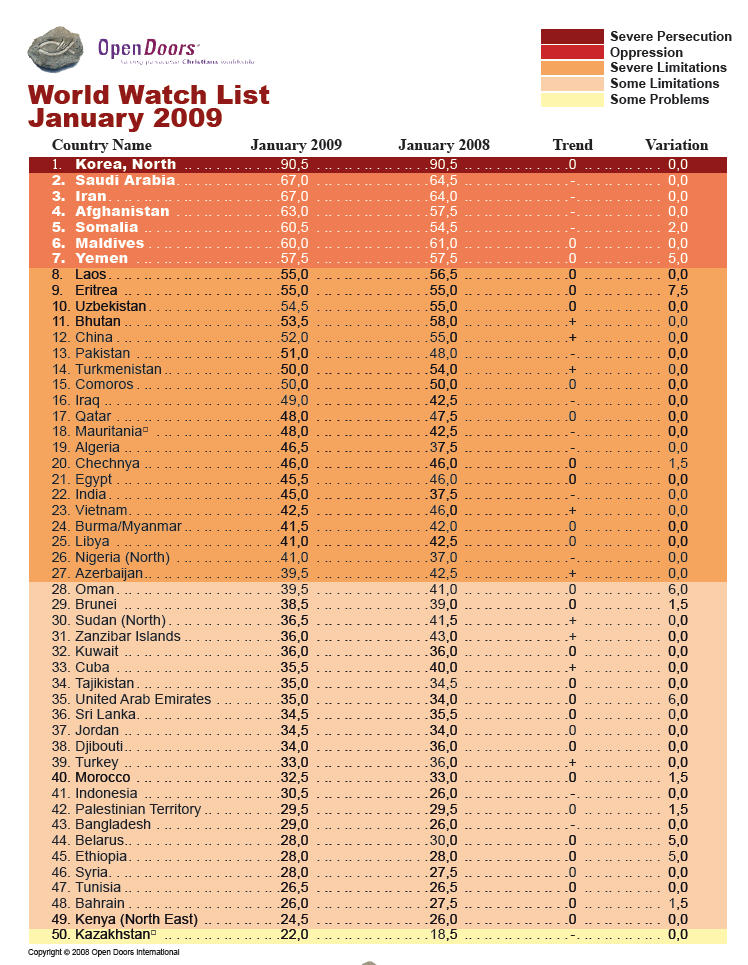
Here  – from World Watch List – are the countries where Christians are most vigorously persecuted:

world-watch-list

Does anyone still think that Kairos is seriously interested in justice?