Bishop Michael Bird to proceed with same-sex marriage

The voting on the marriage canon change is only just over and the Diocese of Niagara bishop, Michael Bird, has already declared that he intends to ignore the vote and go ahead anyway. He claims that “several other bishops” will do likewise, confirming the prediction by Fred Hiltz that, if the motion fails, there will be “civil disobedience”.

Somehow Bird has managed to squeeze from the absence of any motion or canon explicitly forbidding same-sex marriage, the idea that he has tacit authority to proceed. In other words, anything not expressly forbidden by the canons is permitted. As Ivan Karamazov almost said: “If the Canon does not exist, everything is permitted.”

Why did they bother with a vote in the first place? Why even have a synod?

The rule of chaos begins in the Anglican Church of Canada; perhaps I should say “continues”.

From here (my emphasis):

STATEMENT BY THE BISHOP OF NIAGARA

The General Synod of the Anglican Church of Canada has narrowly voted against a change in the marriage canon that would have enshrined equal marriage within our national canons. This decision is deeply regrettable and inconsistent with the ever more inclusive witness of our Church that has inspired this synod’s theme: “You are my witnesses” (Isaiah 43).

The Report of the Commission on the Marriage Canon, ‘This Holy Estate, provides a sound and compelling mandate to move forward with an understanding of the sacrament of marriage that is inclusive for all people, regardless of sexual orientation. Over the past few months I have heard from an unprecedented number of faithful people from across the Anglican Church of Canada expressing support for this vision which upholds the dignity of every human being. I am also mindful that it has been over a decade, in 2004, that our Church affirmed the “integrity and sanctity of committed adult same-sex relationships.”

In the words of David Jones, the chancellor of General Synod, our current marriage canon “does not contain either a definition of marriage or a specific prohibition against solemnizing same-sex marriage.” At the same time, it is clear that our Anglican conventions permit a diocesan bishop to exercise episcopal authority by authorizing liturgies to respond to pastoral needs within their dioceses, in the absence of any actions by this General Synod to address these realities.

Accordingly, and in concert with several other bishops of the Anglican Church of Canada, it is my intention to immediately exercise this authority to respond to the sacramental needs of the LGBTQ2 community in the Diocese of Niagara. In the absence of any nationally approved liturgy, I am authorizing The Witnessing and Blessing of a Marriage and The Celebration and Blessing of a Marriage 2 for use in our diocese. These newly created rites of The Episcopal Church in the United States of America may be used for the marriage of any duly qualified couples. Clergy intending to use these rites will, for the time being, be required to notify the Bishop’s Office in advance.

I offer this witness to the transformational power of God’s inclusive love while acknowledging the considerable differences that exist within our beloved Church. My sincere hope is that God’s grace will inspire all Canadian Anglicans to continue to break bread together in the days ahead. I want to say, as a bishop charged with guarding the faith, unity and discipline of the Church, that I solemnly pledge to do my part to ensure that this is indeed the case.

Please join me in praying for God’s constant presence, guidance, and comfort as we move forward.  Pray for our Church: local, national and universal; as its discernment continues on this matter. And my dear friends pray especially for the global LGBTQ2 community that continues to face unjust and often horrific discrimination, oppression and violence for openly being the people God created them to be.

Motion to change marriage canon fails

The motion to change the marriage canon to allow the marriage of same-sex couples has failed to pass. To pass, the vote had to have a 2/3 majority for laity, clergy and bishops. It was very close and, interestingly, in spite of the bishops declaring they would not have the necessary majority – they did; it was the clergy that prevented the motion passing.

The numbers were (66.7% needed in each category for it to pass):

Bishops Yes: 68.2%
Clergy Yes: 66.23%
Laity Yes: 72.2%

Bullying at General Synod

Apparently some at synod have felt bullied and “unsafe” in their discussion groups. No information is at hand as to the nature of the bullying, so one is left to speculate. Have clergy brought guns to the synod? Knives? Are legs and arms being broken with baseball bats?

Or are tender souls shrivelling under the onslaught of vigorous disagreement. Poor dears. Whatever it is, the Primate is calling for holy manners – whatever they are.

From here:

In an impromptu speech and prayer that lasted nearly 20 minutes, Archbishop Fred Hiltz, primate of the Anglican Church of Canada, sternly reminded members of General Synod to show “holy manners” toward one another when discussing same-sex marriage in their neighbourhood groups.

“Some of the neighbourhood groups, as I understand it, have worked very well, and indeed are eager to get back together,” he said.

“For some there was more of a challenge, and for some, very difficult experiences. And it has come to my attention, as a pastor to this community and this church, that some of the behaviour that’s been exhibited has been less than the standard set out in these norms,” Hiltz said, referring to the eight guidelines members were instructed to follow to ensure a respectful level of debate in their groups.

“Some members of synod have experienced bullying. Some members of our synod are deeply hurt. Some of them are deeply offended. Some are feeling unsafe to continue to speak lest they be reprimanded, and so they’re feeling silenced,” Hiltz said.

“This kind of behaviour is not appropriate,” he said. “It’s unacceptable. And it ought not, and I pray will not, be tolerated.”

Asking the wrong question about the conscience clause

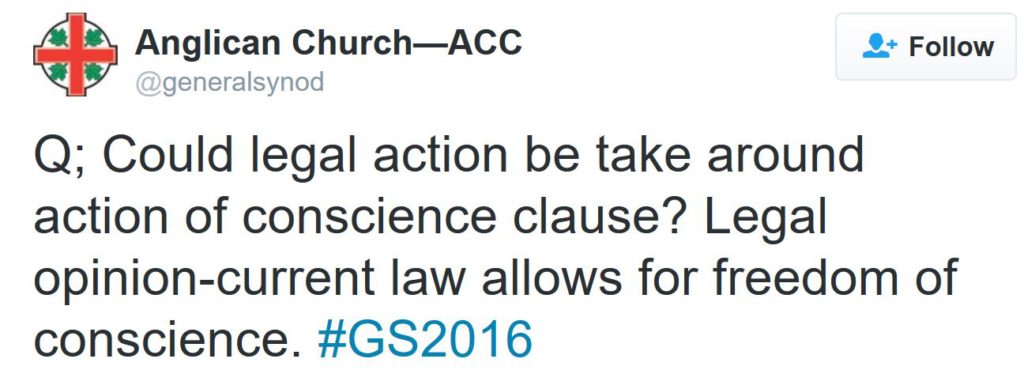
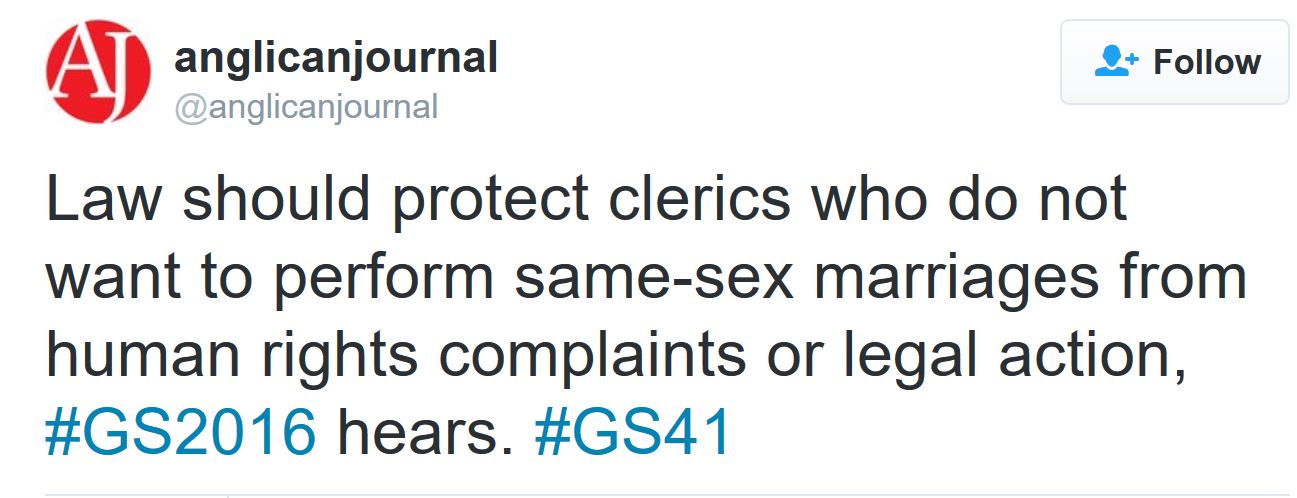
There is a “conscience clause” that will permit clergy to opt out of marrying same-sex couples if a change is made to the marriage canon. The question was asked at synod whether legal action could be taken against a cleric who refuses to marry a same-sex couple:

t1 t2

This was the wrong question to ask. What should have been asked was: “if I do get sued will the Anglican Church of Canada pay for my defence?” The law will  not protect a clergyman – an expensive defence lawyer will. That will be the real test of the ACoC’s commitment to the conscience clause.

Preparing the fudge at General Synod

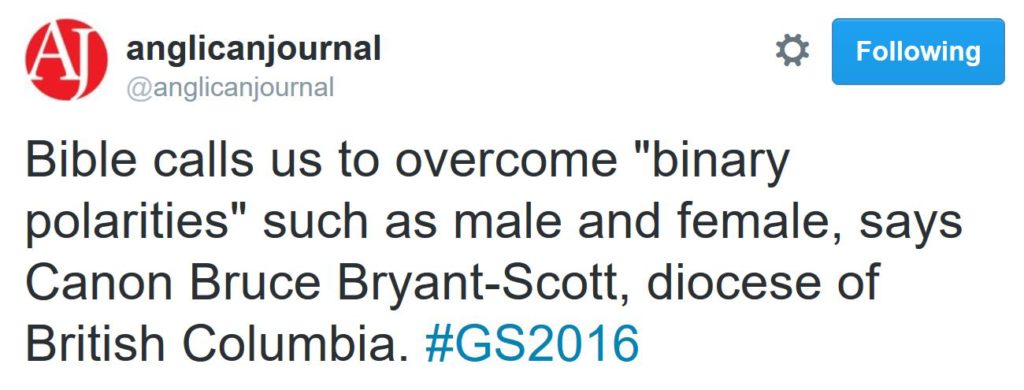
A plot is afoot to prepare delegates for something other than a yes or no decision for the marriage canon vote – resolution C003 – on Monday. The liberals fear that the vote will not go their way so machinations are underway to produce the desired result no matter what the outcome of the vote. Something less “binary”.

From here:

panel

But he [Dean Iain Luke] added that given the deep divisions that exist within the Canadian Anglican church on matters of doctrine, the church should look at new ways of framing its decision-making process that do not inevitably lead to a binary of winners and losers.

It was a position Ambidge agreed with.

“I don’t think the Westminster parliamentary system is serving us well for things other than budgets,” he said. “For things that hit us not in the head or the heart but the soul, I think we need to learn a whole lot from the Indigenous people, because Westminster is really not helping us at all.”

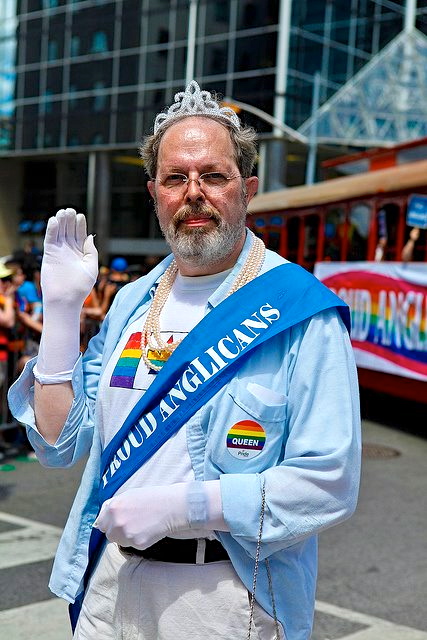
Here is the fellow on the left after he slipped into something more comfortable – less binary, perhaps – for the Pride Parade:

QueenChris

Same-sex marriage discussions begin at General Synod

Synod delegates have asked to discuss three seemingly innocuous questions:

After an introduction to the report of the commission on the marriage canon  presented by some members of the commission, General Synod members, seated at roughly 30 tables, were asked to discuss three questions with the others at their tables: What is your overall impression of the report? What does marriage mean to you? Has your understanding of marriage changed in your lifetime?

Whether same-sex activity is right or wrong is not being discussed. That is because the ACoC has already decreed that same-sex activity can be holy. Once you have gone that far, marriage is a small next step; conservative Anglicans have been fighting a rearguard action ever since and, short of a miracle – a commodity in short supply in the ACoC – the liberal juggernaut will roll on until it gets its way.

Since General Synod 12 years ago already affirmed the sanctity of adult, committed, same-sex relationships, Jennings said, “we did not see it as our job to reopen the debate as to whether homosexuality is fundamentally sinful or whatever—that is no longer the teaching of our church. I realize that for some of you, this might seem unsatisfactory, but it was not the question before us.”

Reaction to Fred Hiltz’s presidential address

Amidst the predictable sycophancy from Hiltz’s employees, the youth delegate from the Diocese of Caledonia – one of the few dioceses to have a theologically conservative bishop – hits the nail on the head. The address was tendentious.

Rather comically, there is a comment under the article that claims the bias is not only acceptable but required because, under canon law, the primate is supposed to speak and write prophetically to the Anglican Church of Canada.  It must be pure coincidence that this is the first time ever that a “prophecy” has been lifted wholesale from contemporary secular values.

Read all the reactions here:

Asher Worley, youth delegate, diocese of Caledonia
For me, basically, he clearly had an agenda, and in my view, the chairperson—the chairman of a meeting like this—simply needs to be more neutral, so I felt that he was being inappropriate in that way. He had his opinion, and it wasn’t veiled. I guess that it wasn’t veiled is a good thing, but that he had an opinion in the first place, and that he expressed it, was, I believe, inappropriate.

What he said was not unexpected, but it wasn’t—let’s put it this way: I don’t agree. I’m trying to think of a way to put this so that I’m not being rude or discourteous. I was looking for a more neutral, this is what we’re doing, but we have to still be in God’s Word, and we have to be searching the Scriptures, because as a church, our main objective is to preach God’s Word—so it was just not what I was looking for in my primate.