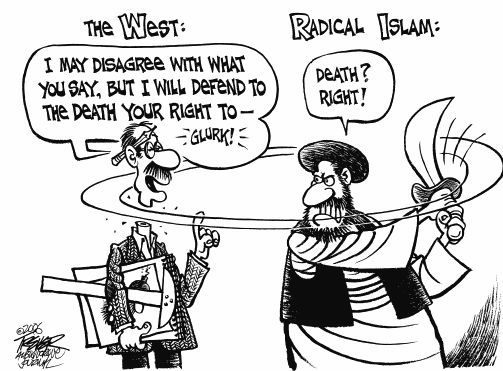
Islamic Free Speech
3

Mosque (that didn’t actually catch fire): Firebombed! The whole building could have caught fire! Could have been very serious! Hate Crimes Unit springs into action! Here:
A mosque in Hamilton was firebombed early Monday, prompting an investigation by the police force’s hate crimes unit.
A rock was thrown through a window at an Islamic school at the Hamilton Mosque sometime after midnight, police said.
A Molotov cocktail was then either thrown or placed inside the window, causing a blaze that petered out without causing significant damage, police said.
“It could have been very serious,” said Zakir Patel, the principal at the Islamic School of Hamilton.
“The whole building could have [caught] fire.”
Staff discovered the damage when they entered the building on 1545 Stone Church Road E.
The Hamilton police hate crimes and arson units are investigating the incident.
Church (destroyed by fire): Fire is “suspicious”. Gasoline canister found – one can speculate; there could be a connection. Maybe the gas can was empty. Arson suspected – oh well, one less church. Hate Crimes Unit conspicuously absent. Here:
Arson suspected at historic Whitby church.
Police called the fire “suspicious” and are treating the area as a crime scene. They are asking any witnesses to come forward to help with their investigation.Police confirmed a gasoline canister was found outside the church. “At this point, we haven’t made an actual determination that that has something to do with the fire,” said Jamie Grant, a Durham police spokesman.
“One can speculate … there may be some connection.”
It is not immediately clear whether the canister was empty or full.
I met Bishop Moses Tay around 1990 when I was leading the musical part of the worship at a conference in Canada where he was the main speaker. I can’t really remember much about the theme of the conference or exactly what he said, but one thing sticks in my mind. He said something to the effect that “The besetting sin of North American Christians is that we are too sensitive, too quick to have hurt feelings; we are unable to take criticism”. He definitely used the word “sin”. And I think he was right.
It was refreshing then to hear an Anglican clergyman speak plainly and honestly and it is still refreshing to hear retired Archbishop Moses Tay speak, this time about the Anglican Covenant (the following are extracts):
…. he has advised fellow Anglican leaders not to waste their time on church structures which the Bible describes as dung and instead to concentrate on the supreme tasks of evangelism and discipleship, which he has succeeded in doing in America.
“To me, at best, it (the Anglican Communion Covenant) is whitewashing so the Church remains one and is not split; a lot of crack underneath is not shown,” said The Right Reverend Moses Tay, the immediate past Singapore Anglican bishop and former archbishop of the Anglican churches in Southeast Asia and Nepal.
Speaking today in an exclusive interview with The Christian Post, the retired archbishop said the covenant will not solve the essential problem of the Anglican Communion, which he identified as a crisis of biblical orthodoxy where the historic Anglican counterpart in America has embraced immorality and refuses to repent of it.
“It’s (the success of the Anglican Covenant) dependent on their willingness to repent, but they (the leaders of the American Anglican Church) have no fear of God,” he said, comparing them to Eli, a priest in the Bible whose sons died because he failed to discipline them.
“None of the resolutions have worked. None of the committees have worked,” said archbishop Tay. He described the Anglican Consultative Council, a ‘major decider’ in the Anglican Communion, as ‘U.S.-controlled.’
The archbishop depicted the covenant as an attempt to “draw a bigger circle to include both the gays and the non-gays.”
Some sincere evangelicals support the idea, he said, on the premise that Christians have a responsibility to facilitate the conversion of the liberals, something that cannot be done if they are to cut the latter off from the denomination.
They justify their view by highlighting that Jesus Christ Himself made friends with sinners and so should Christians.
“But Jesus accepting them (sinners) as friends is different from condoning their sins,” said Archbishop Tay, adding that in spite of the attractiveness of human reasoning the Bible is consistent in its warning that no mortal sinner, apostate, homosexual will enter the Kingdom of God.
Filling with passion, the archbishop said: “The Anglican Covenant cannot be of God because if you try to keep the light and darkness together, righteous and immoral together, to say we are a church, it’s disparaging the meaning of covenant… the covenant is a very sacred thing… [It is] God saying, ‘You will be Mine.’ … If you are using the sacred word to include dirt; that use of the word is an abomination.
“I cannot see how Bible-believing people can agree to the covenant,” he said, calling for spiritual ‘discernment’ on the part of Anglican leaders.
He also criticised leaders today for lacking the ‘guts’ to stand up for their convictions.
The archbishop said: “Church leaders will not even sacrifice a little bit of pride for the sake of truth. That is the darkness of the church leadership today. It is too much arrogance, too much human understandings… too much false grace, too much false unity, too much false humility.”
Archbishop Tay said that not only is the covenant an act of disobedience, it is also harmful to the denomination at large.
He said: “For me it’s very simple. If a thing is right it is right. If a thing is wrong it is wrong.”
During the two-hour interview, the archbishop questioned the personal conversions of the spiritual leader of Anglicans worldwide, the Archbishop of Canterbury Rowan Williams, and the presiding bishop and other leaders of the established U.S. Anglican Church.
It is because of Archbishop Williams’ failure to speak out against the actions of the U.S. church, he said, that the Anglican Communion is facing the threats of biblical liberalism and of a split – evangelical Anglicans like Archbishop Tay feel that a split has already occurred since conservative leaders held a meeting last year in Jerusalem seen by some of them as an alternative to an all-important conference held every ten years in Canterbury, U.K., for Anglican archbishops and bishops worldwide – between the evangelical and liberal camps.
Archbishop Williams, who is recognised as a liberal, has been ‘accommodating’ the point of view of pro-homosexuality liberals on the grounds that some of them are religious in his view and that a split is an embarrassment and must be prevented at all costs.
As for U.S. Presiding Bishop Katharine Jefferts Schori, she has said that “salvation in Jesus is a heresy,” Archbishop Tay said.
The U.S. denomination ‘hates’ the people of God, Jesus Christ and the Word of God and wants to be ‘equal partners’ with the Archbishop of Canterbury, he said.
Clear, direct, honest and – correct.
God likes a laugh too:
AN atheist rapist has complained that his human rights were breached by having to share a prison cell with a Christian lag.
Barman Steven Relf, 40, was jailed indefinitely after admitting raping two women he targeted when he served them drinks in a pub.
Police branded him a “sexual predator” and said he could have had as many as 40 victims.
In a letter to an inmates’ magazine, Relf wrote: “I recently had the displeasure of sharing a cell with a Bible-thumping believer.”
A source said Relf was “furious” at having to share at Manchester Prison with the Christian convict and wanted him to be “evicted”.
He said: “He moaned about how the guy wouldn’t shut up about God. He said he wanted to speak to a lawyer about his rights so he could be moved cells.”
Thus begins a new era of crime deterrence: convicted criminals will no longer be incarcerated; instead they will be forced to attend church and listen to sermons.
I thought it was just a Canadian problem; apparently not:
“Bishops have got a lot nastier”, says the Reverend Gerry Barlow, chair of the faith workers branch of Unite.
Unite says the bullying frequently comes from superiors within the church who may be under financial pressure.
“A bullying case can go on for a long time”, says Terry Young, a former minister who runs the helpline.
“They’re picked on for everything they do wrong, so in the end the person runs around terrified. You see these people unsupported, driven into depression and a nervous breakdown.”
Mr Barlow said: “Bishops can treat people shamefully. The most common experience is a priest gets called in for a pastoral chat, to ‘see how things are going’, within half an hour he’s telling you he’s going to fire you or take your licence away”.
The Anglican church is being run like a business: rather than being shepherds, bishops have become executives, more preoccupied with the well being of the organisation than the people in it.
A far cry from a more humble view of the role of bishop: to be a slave of slaves.
Update: Ruth Gledhill has more on this here.
Canon Harold Munn, writing in the Anglican Journal is happy to let people think of God is any way they choose:
“Not,” I was quick to add, “that it’s necessary to believe in God as an external being watching us—there are a variety of ways of thinking about this—for some people it’s more like deep goodness, or deep reality. But however we imagine it, it’s certainly been present and working through us as we re-design systems to serve those in need. What’s happened is quite wonderful. And I just wanted to say so.”
He’s also happy to let people think just about anything can be a “holy book”:
“I stood before the judge, and she said, ‘What’s that?’ I held it out for her to see. ‘Looks like an Act,’ she said. ‘What Act?’”
“It’s the Canada Health Act. It’s my holy book.”
“That is my holy book. It says there is no distinction between rich and poor. Everyone deserves to be well. That’s holy to me.”
And, since the health act is holy and God is any creation of our choosing:
The Canada Health Act is how God is experienced by a senior government administrator.
Altogether a fine summary of the theological sophistication of the ACoC: forget all the trite nonsense like, In the beginning was the Word, and the Word was with God, and the Word was God. For Anglicans in the 21st C, in the beginning – well around 1984 – was the Canada Health Act and the Trudeau was with the Canada Health act and the Trudeau was with God and the Canada Health act was God.
Primate Fred Hiltz has always denied that the Anglican Church of Canada has a concerted strategy in dealing with parishes that have left the ACoC for ANiC, supposedly preferring instead to let each diocese come up with its own plan. These minutes from the Diocese of BC synod from 2008, while not new, seem to indicate the reverse:
Bishop’s Remarks
The Bishop reported that the Diocese was back in Court on May 8th concerning the building currently being used by the Anglican Network. This was previously the home of the parish of St. Mary, Metchosin. Mme. Justice Allan reserved Judgement. It is hoped the Judgement will come in two or three weeks. The Affidavits were extensive. The Reverend Larry Scyner is the Priest-in-Charge of St. Mary, Metchosin. There is a sense in the parish of quiet satisfaction and encouragement about moving ahead.The Bishop, the Chancellor and the Diocesan Executive Officer are going to Toronto on Monday, May 26th to meet with the leadership of other Dioceses which are in similar situations. The discussions will include the possibility of sharing legal fees. The Diocese of British Columbia has already spent about $40,000 and the Diocese of Niagara has spent about $250,000.
As of 2010, the Diocese of Niagara has already spent well over $320,000 on legal fees and has been rather shy about saying where the money is coming from; perhaps it is scrounging from other dioceses. One aspect of the legal proceedings between the ACoC and ANiC is not mentioned by sober, restrained, respectable people, so I thought I’d bring it to light: a side-benefit of the lawsuits is that it is depriving the ACoC of funds that it might otherwise use to the detriment of the Gospel. Admittedly, the money is ending up in the hands of lawyers, but even lawyers do less damage to God’s kingdom than the Anglican Church of Canada.
As the Anglican Journal points out, Primate Fred Hiltz isn’t very happy that the Government of Canada isn’t listening to him; I’m not sure why they would – no-one else does:
In his address, Archbishop Hiltz said the recent cut of $7-million in CIDA funding for KAIROS, the ecumenical church coalition that includes the Anglican Church, “denies hope for millions of people throughout the world and damages our reputation among the nations.”
Archbishop Hiltz said, “This crisis highlights the need for the churches to have a Secretariat for Government Relations here in the nation’s capital.” He added, “Given the multicultural and multi-religious complexion of our country, such a secretariat could reflect a strong partnership in the interest of human rights, among people of a variety of faith traditions.”
If Hiltz were bewailing the fact that the Canadian government is somehow preventing the myriad of good works that the Anglican Church of Canada is eager to perform if only the right-wing government of Stephen Harper would allow it to, his peenging might make at least a modicum of sense. As it is, Fred is pressuring the government to squeeze more money out of Canadian taxpayers – most of whom are not Anglican – to fund the projects that he, Hiltz has deemed worthy of support.
Instead of playing politics, perhaps the ACoC should try being a church, win souls for Christ and his eternal kingdom and do its own good works – quickly before it goes bankrupt.
In his New Year’s Day address, Primate Fred Hiltz brings up the Anglican Covenant and the little difficulty that it might create for the Anglican Church of Canada:
The Covenant also speaks about procedures for addressing controversial issues and actions by provinces that could be deemed “incompatible” with the spirit of the Covenant, and of “relational consequences” for that province and its place in the Communion. For some, the language of relational consequences is deeply disturbing, given that our relationships within the Anglican Communion are and should never be dependent or fixed on one issue only.
I maintain that in the midst of our differences over issues of sexuality we are called to model a capacity to live with difference and to do so with grace. It is precisely a lack of graciousness that has fired tempers and sparked words of condemnation and dismissal that have been so destructive to relationships within the Communion. I pray that our attitudes and conversations with one another be more and more centered in Him in whom, beyond our understanding, we are forever one.
Hiltz’s reasoning seems to be along the lines of:
He goes on to say:
As we prepare for conversations about sexuality at General Synod it is very clear that people favour conversation and discernment over resolution and debate. Many hope that our discussions will be marked by a capacity to hear one another’s perspective and to appreciate the diversity of settings in which the pastoral and sacramental ministry of the Church is desired. My own hope is that we will emerge from the Synod with an honest statement of where we are in our continuing discernment.
Endless talk without resolution = Good. Disagreeing with each other = Bad. I hate modern pseudo-psychological catchphrases, but I can’t help noticing that this is a perfect description of “dysfunctional”: no-one says what he really thinks in order to maintain the pretence that everyone is getting along just fine.
And to follow:
Personally I am both challenged and heartened by a comment made by the Pastoral Visitors in their report to the Archbishop of Canterbury, “General Synod will, indeed, be a watershed, both for the Anglican Church in Canada, and for its wider relations within the Anglican Communion. At its worst it could lead to internal anarchy. At its best it could help us all to appreciate and practise a properly Christian style of inclusiveness. … Our distinct impression was that if the Anglican Church of Canada could find a way through this current impasse, it could well become a vibrant model of the kind of renewed Christian community that has much to teach the wider Church.”
To put it another way: “Rowan hasn’t managed it, but if you find a way to convince Christians to get along with Unitarian Gnostic New-Age Pantheists, we’ll give it try, too. Hint: try smaller Indaba groups; good luck, Fred.”
Rowan Williams, Utopia Chaser, bemoans the last ten years:
The last 10 years have been “gruelling and terrible” but they should not deter people from helping the poorer and needy living thousands of miles away, says the archbishop of Canterbury.
In his new year message, to be broadcast tomorrow, Dr Rowan Williams will say that people can still make a difference in spite of the “terrorism, war, natural disaster and financial collapse of the last 15 months”.
There was one bright spot, though:
the archbishop also expressed his disappointment at the lukewarm commitment to achieving the millennium development goals.