Vatican to evangelise atheists – some atheists

From The Independent:

The Vatican is planning a new initiative to reach out to atheists and agnostics in an attempt to improve the church’s relationship with non-believers. Pope Benedict XVI has ordered officials to create a new foundation where atheists will be encouraged to meet and debate with some of the Catholic Church’s top theologians.

The Vatican hopes to stage a series of debates in Paris next year. But militant non-believers hoping for a chance to set senior church figures straight about the existence of God are set to be disappointed: the church has warned that atheists with high public profiles such as Richard Dawkins and Christopher Hitchens will not be invited.

As a Christian I believe that no-one is beyond redemption: Christ died for all sinners. It is interesting, then, that the Catholic Church – which presumably believes the same thing – is planning on excluding some atheists from their evangelistic endeavours. The only sentient creatures whom we would normally view as excluded from Christ’s offer of salvation are the demons of hell led by Lucifer himself – in whose company the Catholic church seems to have placed Dawkins and Hitchens. A satisfying thought, but perhaps a tad harsh.

On Yahoo, Islam is a forbidden word

Yahoo News allows the public to make comments on its news articles.

The funny thing is, @#$% is substituted for “Islam” in every comment. For example, in comment 19 here, I entered:

Why is Islam being changed into special characters and Christianity, Buddhism, Hinduism and Taoism  are not?

What was posted was:

Why is @#$% being changed into special characters and Christianity, Buddhism, Hinduism and Taoism are not?

Surely this could not be another example of a pusillanimous Western technology company, could it? It must be a variant of the infamous Google “bug”.

ACoC Director of Philanthropy “resigns”

From here:

The executive director of the department of philanthropy for the Anglican Church of Canada has resigned, effectively immediately.

Dr. Holland Hendrix was appointed executive director of General Synod’s new philanthropy department in October 2008.

“…this morning the Primate (Archbishop Fred Hiltz) and I accepted the resignation of Dr. Holland Hendrix as executive director of philanthropy. …,” said Sam Carriere, acting general secretary of General Synod, in a statement. “We wish him well in future endeavours.”

Anyone who has worked in a large organisation knows what the above coded message really means: he was fired. Perhaps it was this less than stellar idea that brought about his premature demise.

Anglicanism in 2010

Once upon a time there was a family living in a house in the Province of Manglia. It was a clean house with clean children who drank clean water from the well owned by the landlord. The landlord maintained the well, following carefully the instructions in the big black Well Manual.

For many years the family lived happily and got on wonderfully with the landlord.

One day, when the well was due for its scheduled maintenance, the landlord (who, to tell the truth, was bored with the same old maintenance routine), decided to try something different, something that the Well Manual said Really Shouldn’t Be Done: he tossed a dead sheep down the well.

Before long, the family noticed that their once clean water didn’t taste quite right; they complained to the landlord, but he told them that the water just had one of many diverse flavours that they would eventually get used to. He pointed out that nobody likes change at first.

The family wasn’t happy, but the neighbouring Province of Ganglia generously routed some of the water from their clean well to the family. Now as everyone knows, strictly speaking, unauthorised pipelines across other landlords’ Provinces are Bad Manners, so although the family was happy, the landlord of Manglia was furious that the landlord of Ganglia had had the effrontery to question his prophetic, pastoral well-management innovations and ship in foreign water.

So the family and the landlord of Manglia both appealed to the Landlord of all the Provinces – known collectively as Tanglia because they are in a bit of a mess just like the Landlord’s eyebrows – who told the landlord of Manglia to fish the dead sheep out of the well and the landlord of Ganglia to stop interfering and keep his clean water to himself.

The landlord of Manglia responded by throwing another dead sheep down the well; by now he had captured the attention of other landlords who were beginning to think he was on to something. The landlord of Ganglia told the family, “don’t worry, plenty of clean water to go around – even if it is Bad Manners to say so”, upon which the landlord of Manglia decided to evict the family from their house so he could sell it to someone who likes water that smells of dead sheep.

The Landlord was furious and in private stamped his feet and gnashed his teeth; he wanted to throw both landlords down a well.

Of course, being the Landlord, he was obliged to maintain an air of decorum. To punish both landlords he told them that neither was invited to any more parties thrown by the Landlord, nor would they receive the Landlord’s traditional Christmas gift of lava bread made personally by the Landlord from oven-dried Swansea seaweed. That should sort them out, thought the Landlord, rubbing his hands in glee.

Or, to put it another way:

Dr Rowan Williams announced that provinces which had ignored his “pleading” for restraint would be banned from attending official discussions with other Christian denominations and prevented from voting on a key body on doctrine.

He admitted the 80 million-strong Anglican Communion was in a time of “substantial transition” but held back from taking the most serious step of expelling national churches from it.

His action, taken after years of patiently asking both conservatives and liberals to abide by agreed rules, will affect both sides in the dispute over whether the Bible permits openly homosexual clergy.

It has been triggered by the progressive Episcopal Church of the USA, which ordained its first lesbian bishop, the Rt Rev Mary Glasspool, earlier this month. The Episcopal Church also elected the first openly homosexual bishop in the Communion, the Rt Rev Gene Robinson, in 2003.

But the move will also hit orthodox provinces in the developing world – known as the Global South – that reacted to the liberal innovations in America and Canada by taking conservative American clergy and congregations out of their national churches and giving them roles in Africa and South America. This has triggered bitter legal battles over the fate of church buildings.

Katherine Jefferts Schori to walk to Canada for the ACoC Synod

At least – assuming she does not want to participate in our collective sins when she attends GS2010 – that’s how I interpret this:

The still-unfolding disaster in the Gulf of Mexico is good evidence of the interconnectedness of the whole. It has its origins in this nation’s addiction to oil, uninhibited growth, and consumerism, as well as old-fashioned greed and what my tradition calls hubris and idolatry. Our collective sins are being visited on those who have had little or no part in them: birds, marine mammals, the tiny plants and animals that constitute the base of the vast food chain in the Gulf, and on which a major part of the seafood production of the United States depends. Our sins are being visited on the fishers of southern Louisiana, Mississippi, Alabama, and Florida, who seek to feed their families with the proceeds of what they catch each day. Our sins will expose New Orleans and other coastal cities to the increased likelihood of devastating floods, as the marshes that constitute the shrinking margin of storm protection continue to disappear, fouled and killed by oil.

Fred Hiltz is to be a missional primate

From the ACoC:

A missional Primate?
What is the Primate’s role in the Anglican Church of Canada? Over the past three years, the Primatial Role Task Force explored this question through historical research and consultation with active Anglicans.

What does “missional primate” mean? It’s hard to tell, but the ever helpful Wikipedia advises us that:

Missional living” is a Christian term that describes a missionary lifestyle; adopting the posture, thinking, behaviors, and practices of a missionary in order to engage others with the gospel message. The use of the term missional has gained popularity at the end of the 20th Century due to Tim Keller, Ed Stetzer, Alan Hirsch, the Gospel and Our Culture Network, Allelon, and the Emerging church movement, as well as others to contrast the concept of a select group of “professional” missionaries with the understanding that all Christians should be involved in the Great Commission/mission of Jesus Christ.

This seems to imply that to be a “missional primate”, Fred Hiltz would have to cease being a professional clergyman, give up his salary and become a normal Christian – good news indeed.

Christianity Today, thinks that:

A missional theology is not content with mission being a church-based work. Rather, it applies to the whole life of every believer. Every disciple is to be an agent of the kingdom of God, and every disciple is to carry the mission of God into every sphere of life. We are all missionaries sent into a non-Christian culture.

Missional represents a significant shift in the way we think about the church. As the people of a missionary God, we ought to engage the world the same way he does—by going out rather than just reaching out. To obstruct this movement is to block God’s purposes in and through his  people. When the church is in mission, it is the true church.

This is written by Alan Hirsch, who goes by the nails-on-a-blackboard title of “missional activist”. Here we are told to go out, not just reach out – although I am unsure of the distinction.

It is instructive to enter “what is missional” into google; from the results, it seems that the term is sufficiently slippery to appeal to just about anyone who is not allergic to trendy words.

In spite of the fact that I am all for taking the Gospel – the real Gospel – outside the church walls, my unease with what appears to be yet another fruitless attempt to build the Kingdom of God on earth before God is ready to participate is not assuaged by things like this:

More and more evangelical and missional leaders have begun to characterize the gospel of justification by faith alone, penal substitution, and the salvation of souls as a “small gospel.”

Why is that a “small gospel”? What could be larger than the salvation of even a single soul, over which the angels of heaven rejoice?

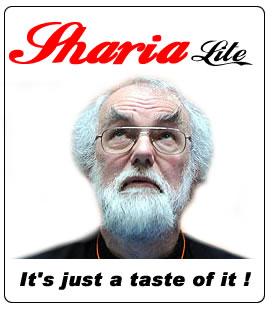
Rowan Williams the dhimmicrat

From American Thinker:Add an Image

What’s a dhimmicrat, you say? It’s not the same thing as a Democrat. A dhimmicrat is a person who, while not Muslim himself, nonetheless clears the path for shariah law to be adopted and incorporated into otherwise free nations.

One prime example of this would be the Right Rev. Rowan Williams, Archbishop of Canterbury. Normally, you would think this top Anglican cleric, who lives in a palace in London, would appreciate Britain’s history as the world’s leader in the Rule of Law. As a minister of the Gospel, Mr. Williams might see his country as a Christian country. Bishop Michael Nazir-Ali, an immigrant from Pakistan, has tried heroically to awaken Britons to their peril. Bishop Nazir-Ali says English law and the Christian religion are the two things that make Britain great. And every day, dhimmicrats like Rowan Williams are trading away their birthright for a mess of pottage. Rowan Williams said Britain must accommodate herself to shariah law in large swaths of her urban neighborhoods.

Much as I appreciate American Thinker, the author of this article, Ken Blackwell, obviously has no appreciation for the intelligence, learning and subtly nuanced thinking of the figurehead of the august and hallowed Anglican Communion.

Rowan has pointed out quite clearly (for him) that we have to “face up to the fact” [that] some citizens did not relate to the UK legal system. And he’s right: Britain has thousands of potential Islamist terrorists who have the greatest difficulty relating to the British legal system; to deprive them of the option of being tried by the ideology whose main means of persuasion is to blow people up would be, well, un-Anglican.

An Anglican-Lutheran joining

Anglicans and Lutherans join forces:

The Rev. Brad Mittleholtz has been officially appointed as priest for a newly combined Anglican-Lutheran parish in the Bruce Peninsula. This new expression of the Full Communion relationship between the Evangelical Lutheran Church in Canada and Anglican Church of Canada was celebrated at a service at Trinity Anglican Church in Wiarton, Ont. on April 26.

Seven Anglican churches, which make up the Anglican Parish of the Bruce Peninsula, and St. Peter’s Lutheran church, will share in a ministry but will maintain their own buildings and identities. At the service in Wiarton, members of the parish proclaimed:

We believe God is calling Lutherans and Anglicans
to witness, and the Holy Spirit will enable us to join
in Ministry on the Bruce Peninsula by
sharing, celebrating, and rejoicing in God’s gifts to us.
We believe that in sharing equal partnership, no congregation
will lose its autonomy, identity, integrity, history or traditions.
We believe in working together as disciples
For the spiritual well-being of the people of the Bruce.
We believe in witnessing to God’s message
By sharing both ordained and lay leadership in ministry.

What does this really mean?

[flv:https://anglicansamizdat.net/wordpress/videos/Lemmings4.flv 480 385]

Lost for Anglicans

Lost is over. This is what it was about:

Without appealing to the trappings of organised religion, Lost dealt – albeit less than coherently  – with good, evil, sin, redemption and the immortality of the human spirit; so it could legitimately claim to be “spiritual, not religious”, the title, coincidentally, of a conference sponsored by the Diocese of New Westminster:

Our keynote speakers understand the spiritual and religious culture of this region in a way that few people do. It is an example of the bridge building that this group is talking about. The book Cascadia explains how we are a distinctive bio-region and the argument in the book is that it is the geography – the mountains, the fish, the rivers, the continental divide – that has created who we are and has helped shape us spiritually. We are different here, largely to do with the fact that we are at the end of the continent and we have this amazing geography.

It looks suspiciously as if the writers of Lost may have drawn inspiration from the meanderings of this obscure and largely defunct corner of dessicated Canadian Anglicanism: Lost was also about a distinctive bio-region, an island, and the effect that it had on those who lived on it. Lost was not specifically Christian – although one could argue that it had a firmer grip on the human condition than the Diocese of New Westminster, since it acknowledged the reality of sin.

Over time, Western Anglican Christianity has become more preoccupied with spirituality, mystery and arcane ritual, and less with truth; consequently you find a speaker at the conference sponsored by the Diocese of New Westminster saying,

“In South American shamanic ayahuasca ceremonies I’ve surrendered to the pulsing heart of the green world and immersed in Jewish Sabbath and high holy days gatherings with friends. I’ve probably taken too many workshops on a wide array of psycho-spiritual and body-oriented healing arts. Some people might say I’ve eaten too many vegetables! My root-meditation practice is inspired by the Buddhist tradition. For 45 minutes each morning I sit and breathe in loving-kindness, a focusing practice that strengthens the heart’s innate capacity to open, accept and forgive.”

This has descended from mystery to muddle – where it cavorts with the spirituality of Lost in which, had you watched it, you would have discovered:

  • The island has a “heart” of light kept glowing by a stone cork plugging a hole;
  • Human guardians of the island live thousands of years after drinking anything – from wine to muddy water – given to them by a previous guardian;
  • A man who fell down the corked hole can – and does – turn into a plume of smoke at will;
  • Electromagnetism from the corked hole is lethal to humans – apart from one;
  • A sequence of doomsday numbers keeps reappearing: their significance is never adequately explained;
  • The island can move through time when an antique wheel is turned.

This goes on and on and none of it makes much sense, scientifically or metaphysically.

Of course, Lost, unlike the Diocese of New Westminster, isn’t pretending to be a church and endless unanswered mysteries (well, some were answered) are good for ratings; moreover, Lost has accomplished what it set out to do: make lots of money for everyone involved – it has been a resounding success. It even entertained a few people along the way – something the Anglican Church has never been able to manage.