Apparently, gender is irrelevant and those who don’t agree should “die off”

That is the view of the exemplar of tolerance, Glenn Close, who plays a cross dresser in her new film.

From here:

Glenn Close is not a man. And she is not gay. But she so fully assumes the bizarre form of an Irish woman who hides her sex beneath stiff collars and black suits in the new film Albert Nobbs, that you have to recalibrate all notions of gender by the final credits.

Close says that was pretty much the whole idea behind bringing her Obie-winning role to the screen: “Gender is irrelevant. It basically should be irrelevant.”

[….]

Some people will change their point of view, and those who are either too old, or too blinkered, to accept the beauty of difference will just have to “die off,” she says.

Hiding one’s sexual identity by dressing as a member of the opposite sex expresses the irrelevance of gender as effectively as a man in a wig expresses the irrelevance of baldness.

And since cross-dressing seeks to disguise a difference, it’s difficult to see how it enhances the “beauty of difference.”

Perhaps it is Ms. Close’s brain cells that have died off.

In Australia you can now be male, female or X

From here:

Australian passports will now have three gender options – male, female and x.

The new category is only for use by intersex people – who are not biologically entirely male or female.

Trangendered passport-holders – who have changed gender but not had surgery – will be free to choose either male or female, but will not be allowed to select ‘x’.

[…..]

She said: ‘”X” is really quite important, because there are people who are indeed genetically ambiguous and were probably arbitrarily assigned as one sex or the other at birth.

‘It’s a really important recognition of people’s human rights that if they choose to have their sex as “indeterminate”, they can.’

In Western society, being inter-something is an increasing obsession. Interfaith services commemorating 9/11 were popular and were attended by people who believe that proclaiming their non-adherence to any specific religion is more virtuous than espousing the truth of one to the exclusion of the others. The objective reality that if one religion is true the others must be false, has to be resisted at all costs since that would foster exclusiveness and inequality – the antithesis of the only permitted absolutes, inclusiveness and equality.

As the article notes, it has become a human right to deny objective reality. Thus, to insist on the objective existence of a person’s gender is now gauche: a person’s sex is determined existentially. A person doesn’t behave like a man because he is one, he is a man because he behaves like one: behaviour precedes essence.

What next, I wonder: an interspecies category for those whose sexual excess is behavioural evidence of their being rabbits?

The Anglican Journal barely contains its glee in reporting a Catholic favouring same-sex marriage

Apparently, it brings us one step closer to everyone being equal[ly daft].

In the Anglican Church of Canada, agreeing with a government when it wants to introduce same-sex marriage legislation and disagreeing with a government when it introduces spending cuts are both known as prophetic social justice making. A prophecy occurring after the fact would be risible for any institution that was less behind the times than the ACoC, of course: but what else can you expect from a church that consecrates a bishop to the dulcet prophetic tones of All You Need is 1960’s Love.

From here:

Brisbane, Australia – As Australia debates gay marriage, one Catholic member of Parliament, who is in favor, says his faith informs his thinking, but not necessarily his decision-making.

In taking this stance, Brisbane Labor MP Graham Perrett is opposing both his church and his party but said he believes “it is time for this nation to protect committed, monogamous relationships, whatever the gender of the adults who wish to have their relationship recognized by the state.”

Poll reveals that Canadians believe Western and Muslim societies are irreconcilable

From here:

A majority of Canadians believes conflict between Western nations and the Muslim world is “irreconcilable,” according to a new national survey that revealed a strong strain of pessimism in the country leading up to Sunday’s 10th anniversary commemorations of the Sept. 11 terrorist attacks on the U.S.

The survey of 1,500 Canadians, conducted over three days last week for the Montreal-based Association for Canadian Studies, showed 56% of respondents see Western and Muslim societies locked in an unending ideological struggle, while about 33% — just one-third of the population — held out hope that the conflict will eventually be overcome.

Obviously not many politicians or Anglican clergy were included in the poll.


Rev. Gary Nicolosi ruminates on how 9/11 shows us what God is like

From here:

God is like the firefighters who ascended the steps of burning buildings to save those who could not save themselves…

And who could forget the stories of airline passengers and workers at the Twin Towers, knowing they would die, who called others to say, “I love you.”…

And how about all the rescue workers who ploughed through the rubble in the coming days…

True enough, but there was one curious omission which, because of its nature, I can’t help thinking was deliberate.
God is also like this on Flight 93:

The passenger revolt on Flight 93 began at 09:57 after the passengers took a vote amongst themselves about whether to act. By this time, Flight 77 had struck the Pentagon and Flights 11 and 175 had struck the World Trade Center towers. The hijackers in the cockpit became aware of the revolt at 09:57:55, exclaiming, “Is there something? A fight?”…….

The cockpit voice recorder captured the sounds of crashing, screaming, and the shattering of glass. Jarrah stabilized the plane at 10:00:03. Five seconds later, he asked, “Is that it? Shall we finish it off?” Another hijacker responded, “No. Not yet. When they all come, we finish it off.” Jarrah once again pitched the airplane up and down. A passenger in the background cried, “In the cockpit. If we don’t, we’ll die” at 10:00:25. Sixteen seconds later, another passenger yelled, “Roll it!”……

The 9/11 Commission Report concluded that “the hijackers remained at the controls but must have judged that the passengers were only seconds from overcoming them”. However, many of the passengers’ family members, having heard the audio recordings, believe that the passengers breached the cockpit and killed at least one or all of the hijackers.

The passengers of Flight 93 sacrificed their live for others so you would think they might deserve a mention – if it weren’t for that deeply troubling last sentence: they may have  killed some of the hijackers. That’s just not very inclusive is it.


In Canada you can now kill new-borns as well as the unborn

A judge has ruled that since we can kill the unborn no matter how far into the pregnancy, we can also kill new-born babies because of “the onerous demands pregnancy and childbirth exact from mothers”.

I have to admit, it’s logical: logical devilry.

From here:

An Alberta judge has let a woman who strangled her newborn son walk free by arguing that Canada’s absence of a law on abortion signals that Canadians “sympathize” with the mother.

“We live in a country where there is no protection for children in the womb right up until birth and now this judge has extended the protection for the perpetrator rather than the victim, even though the child is born and as such should be protected by the court,” said Jim Hughes, national president of Campaign Life Coalition.

Katrina Effert of Wetaskiwin, Alberta gave birth secretly in her parents’ downstairs bathroom on April 13, 2005, and then later strangled the newborn and threw his body over a fence.  She was 19 at the time.

She has been found guilty of second-degree murder by two juries, but both times the judgment was thrown out by the appeals court.  In May, the Alberta Court of Appeal overturned her 2009 murder conviction and replaced it with the lesser charge of infanticide.

On Friday, Effert got a three-year suspended sentence from Justice Joanne Veit of the Alberta Court of Queen’s Bench.  As a result, she was able to walk out of court, though she will have to abide by certain conditions.

According to Justice Veit, Canada’s lack of an abortion law indicates that “while many Canadians undoubtedly view abortion as a less than ideal solution to unprotected sex and unwanted pregnancy, they generally understand, accept and sympathize with the onerous demands pregnancy and childbirth exact from mothers, especially mothers without support.”


Presiding Bishop Katharine Jefferts Schori displays Islam myopia

On September 11th, Katharine Jefferts Schori preached the sermon at St. Paul’s Chapel in the shadow of Ground Zero. Among other things, she said this:

I saw a pickup truck a couple of weeks ago with a waving American flag painted on its rear window.  As I walked through the parking lot, I realized there was something written on the tailgate – the word ISLAM stood out first.  Finally I saw the whole sorry slogan, “everything I need to know about Islam I learned on September 11th.”  How will we change hearts that seem closed to learning more about peace?

Are we willing to recognize and then proclaim that as children of Abraham, Christians, Jews, and Muslims share that vision of a healed world that Micah paints for us?

That isn’t true – at least, it’s not true in the sense that Jefferts Shori means it. In the majority of Islamic nations there was rejoicing on September 11th, 2001 because America had finally got what was coming to it. The Islamic vision of a “healed world” is one of an Islamic caliphate ruled by sharia law where democracy, free speech and Jefferts Schori style “diversity” have been obliterated.

Here is a not untypical Islamic reaction to 9/11 from Saudi Arabia:

Then we all knew it wasn’t an accident. We heard sporadic yelling in the streets and happy shouts from Saudis in our own hospital. In the terminal cancer ward, patients were hooting and screaming “Down with USA,” much to the horror of the American nurses tending them.

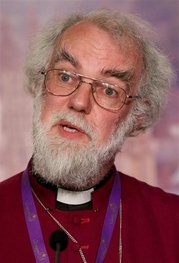
Rowan Williams to quit next year

From here:

Dr Rowan Williams is understood to have told friends he is ready to quit the highest office in the Church of England to pursue a life in academia.

The news will trigger intense plotting behind the scenes over who should succeed the 61-year-old archbishop, who is not required to retire until he is 70.

Bishops have privately been arguing for Dr Williams to stand down, with the Rt Rev Richard Chartres, the Bishop of London, telling clergy he should give someone else a chance after nearly ten years in the post.

Better late than never.


A Christian response to 9/11

Christians inhabit two kingdoms: the kingdom of God and the kingdom of this world. Jesus confirmed this when he said, “Render unto Caesar the things which are Caesar’s, and unto God the things that are God’s” (Matthew 22:21).  The difficulty is deciding which things are God’s and which Caesar’s.

One thing that belongs to God is forgiveness. Not the self-indulgent maudlin corporate forgiveness of those who have next to nothing to forgive, but the painful personal forgiveness that God requires of each of us if we are to receive his forgiveness.

True peace also belongs in the kingdom of God and, as St. Augustine noted, insofar as it is immanent in this world, it is related to but not the same as the peace of this world:

In its sojourn here, the Heavenly City makes use of the peace provided by the earthly city. In all that relates to the mortal nature of man it preserves and indeed seeks the concordance of human wills. It refers the earthly peace to the heavenly peace, which is truly such peace that it alone can be described as peace, for it is the highest degree of ordered and harmonious fellowship in the enjoyment of God and of another in God.

So, as a citizen of both kingdoms, it is a Christian’s responsibility to further the peace of the kingdom of heaven and of this world. Not, however, as many half-baked clerics. They have chosen to be the citizens of a third kingdom: the foggy land of interfaith diversity where earthly peace has supplanted its heavenly counterpart and is supposed to arrive wafting gently on waves of dialogue, candle lighting, mutual back-patting and ecumenical peace quilting.

The Biblical way for a state to maintain peace is by the sword: in other words, through force or the threat of force (Romans 13:2-5). It may appear contradictory to love an enemy while being required by the state to kill him, but it isn’t. As C. S. Lewis put it in “Mere Christianity”:

Now a step further Does loving your enemy mean not punishing him? No, for loving myself does not mean that I ought not to subject myself to punishment even to death. If you had committed a murder, the right Christian thing to do would be to give yourself up to the police and be hanged. It is, therefore, in my opinion, perfectly right for a Christian judge to sentence a man to death or a Christian soldier to kill an enemy. I always have thought so, ever since I became a Christian, and long before the war [WWII], and I still think so now that we are at peace. It is no good quoting ‘Thou shalt not kill.’ There are two Greek words: the ordinary word to kill and the word to murder. And when Christ quotes that commandment He uses the murder one in all three accounts, Matthew, Mark, and Luke. And I am told there is the same distinction in Hebrew…

When soldiers came to St John the Baptist asking what to do, he never remotely suggested that they ought to leave the army: nor did Christ when He met a Roman sergeant-major – what they called a centurion. The idea of the knight – the Christian in arms for the defence of a good cause – is one of the great Christian ideas. War is a dreadful thing, and I can respect an honest pacifist, though I think he is entirely mistaken. What I cannot understand is this sort of semi-pacifism you get nowadays which gives people the idea that though you have to fight, you ought to do it with a long face as if you were ashamed of it. It is that feeling that robs lots of magnificent young Christians in the Services of something they have a right to, something which is the natural accompaniment of courage – a kind of gaiety and wholeheartedness…..

We may kill if necessary, but we must not hate and enjoy hating. We may punish if necessary, but we must not enjoy it.