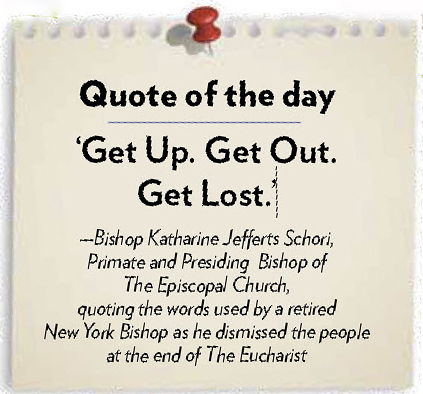
The most superfluous exhortation at the Anglican Joint Assembly

14-07-2013 8-44-39 PMAt the end of a Eucharist at the Anglican Church of Canada’s Joint Assembly, Katharine Jefferts-Schori, one of the invited guests, dismissed the congregation with: “Get Up. Get Out. Get Lost”.

Hundreds of people felt excluded by the dismissal: there were, after all, only three people present who were not already lost.

Reaction to resolution C003, changing the marriage canon to include same-sex marriage

The Anglican Journal conducted interviews after the vote.

Predictably, Peter Elliott, a partnered homosexual from the Diocese of New Westminster, was “happy”:

“very happy to see this small step, an important step being taken.” Elliott acknowledged that the resolution could reopen wounds over the issue of same-sex blessings that have daunted the church in the last decade. But, “it is also continuing in the healing process for some of the wounds that have been there for a long time,” said Elliott. “Nobody has the monopoly on pain. Gay and lesbian people in the life of the church have for some decades been second-class citizens…I think it is a word of healing for those of us who are gay.”

As Elliott says, “Nobody has the monopoly on pain’. What he doesn’t say is that Anglicans who are resisting the temptations of same-sex attraction because they believe succumbing to them would be wrong, will be hurt by this resolution. It seems that their pain doesn’t count because, presumably, in Elliot’s world, they don’t count.

Gene Packwood noticed what, to the un-blinkered, was apparent all along: no matter how strenuous the denials, same-sex blessings in the ACoC were always intended to be a prelude to same-sex marriage, making the liberal Anglican hierocracy little better than a coterie of con artists:

Canon Gene Packwood, a clergy delegate from the diocese of Calgary, said same-sex marriage “was the intent all along. I think folks who are in favour of this were using same-sex blessings to try in the interim to gain ground. I’m not accusing them of being devious, but that was what the strategy was.”

Sue Moxley pointed out another obvious inconsistency in the ACoC’s willingness to bless what it is unwilling to do:

Bishop Sue Moxley, diocese of Nova Scotia and Prince Edward Island, expressed support for the motion. “There’s an interesting dynamic: that people can get their head around blessing a couple but not get their head around marriage,” she said. “For me, that doesn’t make sense because for me a blessing is what a wedding in a church is about.”

Gene Packwood went on to point out that changing the marriage canon in this way will further alienate most of the world’s Anglicans, drive yet more people out of the ACoC, decrease the church’s revenues and further hasten its demise – demonstrating once again the old saw: those whom God wishes to destroy, he first makes mad:

Packwood, who believes that same-sex marriage is “manifestly contrary to the teaching of scripture and the liturgy of the church,” also expressed concern about the resolution’s effect on the Anglican Church of Canada’s standing in the Anglican Communion worldwide. “We’re not in communion with the majority of Anglicans…because they think we’ve gone so far and that’s even without making a decision,” he said. “If we go and change the marriage canon, then that’s really going to draw the line and that won’t be helpful to our spiritual health or our finances.”


The Anglican/Lutheran Joint Assembly draws to a close

The Anglican Church of Canada’s Joint Assembly ended today.

Bishops, clergy and delegates have finally talked themselves out – hope springs eternal – and all are headed home on aeroplanes fuelled by burning the carbon spewing fossil remains resulting from the extraction processes that were roundly condemned at the Assembly.

Since it is the most important meeting that occurs in the ACoC and it only takes place once every three years, it is only to be expected that Anglicans nationwide will have been avidly devouring the reasonably comprehensive coverage provided by the Anglican Journal, making those posts rank highest in popularity.

Or maybe not:

Journal Most Read

Joint Assembly: Resolution to vote on same-sex in marriage 2016 passed

Resolution C003 proposes to introduce a resolution in 2016 to the Synod/Joint Assembly – or whatever it is called by 2016 – to change “Canon XXI on Marriage to allow the marriage of same sex couples in the same way as opposite sex couples”.

The 2013 resolution passed by a substantial majority. Is there any doubt that the resolution to change the canon will pass in 2016?

From here:

General Synod on July 6 approved a resolution that will bring the issue of same-sex marriage to a vote at the meeting of the Anglican Church of Canada’s governing body in 2016.

At its triennial meeting here, General Synod passed Resolution C003, asking the Council of General Synod to prepare and present a motion to change the church’s Canon 21 on marriage “to allow the marriage of same-sex couples in the same way as opposite sex couples.”

Moved by the diocese of Nova Scotia and Prince Edward Island members Michelle Bull and Jennifer Warren, the motion was approved by a two-thirds majority of the orders of bishop, clergy and laity. Using clickers—a handheld electronic device—25 bishops, 72 clergy and 101 laity voted in favour of the resolution; 11 bishops, 30 clergy and 27 laity were opposed.

The Anglican Church of Canada identifies “the critical justice issue of our time”

No, it’s not the unrestricted killing of 65,000 unborn Canadian babies every year, it’s  – wait for it: mining. I expect you already guessed that, though.

From the eco-babbling borborygmus of the Anglican Joint Assembly:

For Canadian especially, resource extraction is “the critical justice issue of our time,” said Jennifer Henry, executive director of the Canadian ecumenical justice group, KAIROS, who addressed the assembly. “We have a tremendous impact on earth and all that’s in it.”

Canada is home to 75 per cent of the world’s mining and mineral exploration companies, and its stock exchanges trade 40 per cent of the world’s mineral exploration capital, Sara Stratton, KAIROS education and campaigns co-ordinator, also told the assembly. In 2011, resource extraction accounted for 11 per cent of Canadian GDP, up from six per cent in 2001, said Stratton.

[…..]

Archbishop Fred Hiltz, primate of the Anglican Church of Canada, and ELCIC National Bishop Susan Johnson both spoke of the need to act on the issue.

“We are all in this together,” said Johnson, adding that the challenge before members is “how to reduce consumption and help generate solutions.”

This must mean that all the delegates are going to walk home.

The Anglican Church of Canada continues to promote a false gospel

According to the Most Rev Dr Eliud Wabukala, Primate of Kenya:

While we give thanks for much that has been achieved, especially in the emergence of the Anglican Church of North America and our Global Fellowship of Confessing Anglicans, we are painfully aware that the Episcopal Church of the United States and the Anglican Church of Canada continue to promote a false gospel and yet both are still received as in good standing by the Archbishop of Canterbury.

Not to worry, though, Resolution A170 R1 (supporting creation care across the church) before the Anglican Joint Assembly currently in session, should banish any lingering doubts that Rev Wabukala may have about whether the ACoC has a firm grip on the Gospel message or not.

As we all know, Jesus devoted much of his ministry to raising awareness of ecological issues and promoting green audits through partnering with Greening Sacred Synagogue Spaces, in order to participate in the Green-Up Database in partnership with the Jerusalem Green Building Council.

I am so excited by all this partnering.

The Anglican and Lutheran Joint Assembly begins

And it’s all about commonplace leftist preoccupations that have little to do with Christianity – like resource extraction – and diminishing membership; could there be connection?

From here:

Hundreds of members of the Anglican Church of Canada and the Evangelical Lutheran Church in Canada are converging on Ottawa for an unprecedented joint national gathering of the two churches, where they will tackle issues like resource extraction, homelessness, and how to live out their mission in a time of diminishing church membership.

The Anglican Church of Canada is claiming “545,000 members”, a grossly inflated number I suspect. After all, my wife and I are still on the membership roll of the Diocese of Niagara even after the bishop sued me. I wonder if that’s a first, a bishop suing one of his own parishioners?

The Anglican Church of Canada (anglican.ca) has been a self-governing member of the worldwide Anglican Communion since 1893 and has 545,000 members in nearly 2,800 congregations across the country.

The ELCIC claims even fewer members – 145,000 – and has joined with the ACoC in the hope, perhaps, of padding its denomination with disaffected Anglicans; another example of resource extraction.

The Evangelical Lutheran Church in Canada (elcic.ca), established in 1986, has 145,000 members across Canada in nearly 600 congregations and is a member of the Lutheran World Federation.

Membership decline is to be addressed by restructuring rather than examining the reason that people are leaving:

Delegates from both churches will also discuss proposals to restructure the way in which the Anglican Church of Canada and the Evangelical Lutheran Church in Canada function, since both churches have experienced the same decline in membership as many other mainline Canadian churches.

Not all mainline churches have lost members: the Roman Catholic Church has experienced membership growth while standing resolutely against same-sex marriage, abortion and euthanasia – could there be a connection?

Anglican Church of Canada Resolution C003: change the marriage canon to allow the marriage of same-sex couples

The Anglican Church of Canada holds its general synod every three years.

Resolution C003 is a motion for the 2016 synod requesting a change to the marriage canon to include the marrying of same-sex couples. Eleven dioceses – New Westminster, Ottawa, Huron, Niagara, Toronto, Montreal, Nova Scotia and Prince Edward Island, Edmonton, Rupert’s Land, Quebec and British Columbia – already offer the blessing of same-sex unions. All offer liturgies for this blessing and all are careful to point out that the liturgies are for the purpose of blessing not marriage itself.

The cynical among us might question whether there is any significant difference between the two and wonder at the depths of hypocrisy to which these dioceses are prepared to stoop in order to deceive gullible congregants: after all, if a church is willing to bless a same sex-marriage why would it refuse to conduct the marriage? The answer lies in how Anglicans effect change: gradually. A rector who wishes to move a piano from one side of the church to the other does it an inch at a time; it may take a year but no one notices.

There can be little doubt that the Anglican Anglican Church of Canada will end up marrying same sex couples. I for one will welcome it; at least it will be a forthright and undeniable capitulation to the Zeitgeist – stupid and flagitious, perhaps, but with less circuitous guile.

Take note, conservative Anglican frogs determined to remain in the Anglican Church of Canada come what may: the water is almost boiling.

From here:

Resolution C003

Subject: Preparation of motion to change Canon XXI on Marriage; Direction to COGS

Moved by: Ms. Michelle Bull, Diocese of Nova Scotia and PEI

Seconded by: Ms. Jennifer Warren, Diocese of Nova Scotia and PEI

Be it resolved that this General Synod

direct the Council of General Synod to prepare and present a motion at General Synod 2016 to change Canon XXI on Marriage to allow the marriage of same sex couples in the same way as opposite sex couples, and that this motion should include a conscience clause so that no member of the clergy, bishop, congregation or diocese should be constrained to participate in such marriages against the dictates of their conscience.

Source: Member

Submitted by: Ms. Michelle Bull, Diocese of Nova Scotia and PEI

Does this motion contain within it any financial implications? Yes No X

If yes, has the General Synod Expenditures Committee considered the implications? Yes No

EXPLANATORY NOTE/BACKGROUND

It has been 6 years since General synod last debated this issue. Since then, some dioceses have proceeded in a manner they deemed necessary to meet the local pastoral and other needs with respect to the blessing of same sex civil marriages. It has been over 10 years since such civil marriages were legal in Canada. The general public has become much more accepting of same sex unions since we last discussed it. This is also true of the church, though not, of course, universally so.

It seems like a good idea to ask COGS to draft this motion, so that it will be done correctly and with the benefit of appropriate legal and theological advice as to wording, so that the motion will do all and only what we wish it to.

We believe that it is necessary that there be a conscience clause so that anyone who is not in favour of same sex marriages will not be constrained to participate in them. It is not our intention to force everyone to conform in this matter, but only to allow those who wish to allow same sex marriage in the church to go ahead.

PROCEDURE FOR ADOPTION (G)

In the normal course, an ordinary motion must be passed by a majority of the Order of Bishops, and by a majority of the Orders of Clergy and Laity voting together.

Six members of General Synod may, prior to the question being put, require a vote by Orders, with a majority of each Order being necessary to pass.

If a question passes on a Vote by Orders, any six members (two from each of three different dioceses) may require a vote to be taken by dioceses. A motion passes if a majority of dioceses (or a tie) vote in favour.

Source: Section 5 of the Declaration of Principles and sections 18, 19 and 20 of the Rules of Order and Procedure

Note: If Resolution A030 is given second reading, the required majority will be all Orders voting together.

Bishop Sue Moxley to retire

moxleyIn what appears to be an epidemic of resigning bishops, first Michael Ingham announced his retirement, then James Cowan and now Sue Moxley, bishop of the diocese of Nova Scotia and Prince Edward Island.

These three bishops have all presided over the instigation of same-sex blessings in their respective dioceses and now, having accomplished their mission and set the cat among the pigeons, are bidding us adieu and leaving their successors to cope with the fallout.

From here:

Bishop Susan “Sue” Moxley, known to many Anglicans in Canada and overseas for her passion for social justice and church renewal, has announced she will retire in March 2014.

By then, Moxley will have served in an episcopal role for 10 years—three years as suffragan (assistant) bishop and seven as diocesan bishop for the diocese of Nova Scotia and Prince Edward Island. She also will have served as an active priest in the Anglican Church of Canada for 29 years. In 2007 Moxley, then 61, made history by becoming the first female bishop elected in her diocese, and the second female bishop to lead a diocese across the Canadian Anglican church.