Rowan Williams’s unwanted political advice

Anglican Archbishops Rowan Williams and John Sentamu exhorted the British public not to punish avaricious MPs by voting for the BNP.

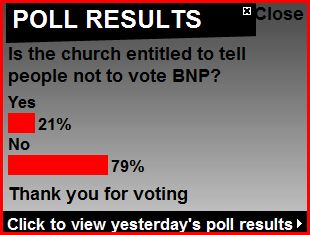
The Daily Mail conducted a poll that illustrates just how out of touch Anglican bishops are with ordinary people – or, at least with people who respond to Daily Mail polls.

Is the church entitled to tell people not to vote for the BNP:

Vote

The youth of the Diocese of Niagara, gender-neutral language and rainbow flags

Youth at the Diocese of Niagara Youth Synod had this to say among other things:

Delegates will be asking their local municipalities and schools to fly the rainbow flag on International Day against Homophobia, and they challenged themselves to offer support to those who have been hurt by homophobic language.

They vowed to take a stand against homophobia and bullying wherever they encounter either. At the successful passing of the Homophobia motion, delegates presented a rainbow flag to St. Christopher’s asking them to fly the flag every May 17. The delegates pledged to volunteer their time and energy to a youth ambassador program that connects parishes to diocesan youth ministry events, and is a presence at diocesan events. And they didn’t stop at challenging themselves! They invited the church to use gender-neutral language in liturgy in diocesan worship services; asked the Diocesan Youth Ministry

Committee and the Program Consultants to set up the Youth Ambassador Program, and to provide training to volunteer staff and Youth Ministry program participants about bullying. Finally, the delegates of Youth Synod 2009 affirmed the Diocesan vision and resolved to continue the leadership role of Youth Ministry as the vision unfolds and they invited Bishop Michael to affirm his commitment to living out the diocesan vision in partnership with them.

Barring the repeal of Pr. 22:6, it’s hard to believe that the youth of the hyper-liberal diocese of Niagara would be this interested in homophobia and gender-neutral language without a little coaching from Michael Bird and his cohorts.

An Anglican Professor of Church History has noticed that the Anglican church is falling apart

Alan Hayes is Professor of Church History at Wycliffe, University of Toronto, and he has this to say about the plight of the Anglican Church of Canada (Page 3):

And now, in 2009, the Anglican Communion gives a very good impression of falling to pieces. Some of this gets blamed on debates about sexuality, but, if you’ve followed me so far, you’ll know that I see deeper and more enduring causes than that.

What’s the way forward? If our problem is what I suspect – that we’re depending on a Vatican II theology which was never really ours to begin with and which is now showing signs of age—then the way forward is theological too. We need to rediscover, together, the faith of our Church. We need to agree on what we stand for, and we need to discern our distinctive theologically grounded mission.

I doubt that techniques of church growth or strategies of relevance will move us ahead until we’ve had our own Anglican Vatican II, and that will mean prayer, self-criticism, ressourcement, and aggiornamento.

This is the first time I have seen Alan openly admit that the ACoC is imitating something that is falling to pieces. Of course, for many of us, it is quite clear that the ACoC isn’t doing an imitation, but actually is falling to pieces: just as Bob Dylan observed you don’t need a weatherman to tell which way the wind blows, you don’t need a professor of church history to tell you what the rotten smell is in the ACoC.

His point that we adopted something that isn’t ours – Vatican II – and that we need our own version is interesting but impossible: we don’t have a Vatican. It has become transparently apparent that there is absolutely no working authority structure in the worldwide Anglican communion; someone other than Rowan Williams might have had the guts to impose order, but it is quite clearly beyond Rowan.

When we see this sort of thing:

the Roman Catholic Church’s new and totally unexpected spirit of self-criticism, its re-thinking of Christian basics, its ressourcement (its return to essential sources, especially Scripture), and its aggiornamento (its passion to come to faithful terms with the modern world).

We may persuade ourselves that in this there is a glimmer of hope, in phrases like return to essential sources, especially Scripture; the glimmer is dimmed when we read: passion to come to faithful terms with the modern world. Rather than plainly say that the ACoC has departed from historic orthodox Christianity, we have something sufficiently slippery that it can used by liberals whose view of coming to faithful terms with the culture is to capitulate to it.

Liberals like Michael Burslem, whose article by a stroke of fortuitous irony, appears on the same page:

In Anglicanism we have neither an infallible pope nor an infallible Bible. The Word of God is our supreme authority, not exclusively the Bible. This is the Logos of St. John’s prologue, which he defines as Jesus Christ. However, since his Ascension he is no longer with us in person, but he did promise to send his Holy Spirit, who is the Logos in the world today. The Spirit certainly speaks to us through Holy Scripture, but also through other means, such as our culture and traditions, other people, (especially our spouses) through visions, dreams, through music, poetry, drama and literature; through the wonders of science; yes, and through common sense. He deals with us individually. There is no ‘one size fits all’ which would be if the Bible alone were our supreme authority.

Here we have entered the realm of sanctified subjectivity: contemporary cultural prejudice justified by the rubber stamp of a bogus holy spirit.

Alan’s way forward, We need to rediscover, together, the faith of our Church, is more of a way sideways:  with nothing explicit in mind, it would be used by liberals to conform the church to contemporary preoccupations while making the claim of returning to the church’s roots.
Is Rowan Williams doing the BNP a favour?

Rowan Williams and John Sentamu are urging British voters to shun the BNP: by this time, everyone expects political peroration rather than spiritual insight from Anglican bishops, and this does not disappoint:

The Archbishop of Canterbury called on people to shun extremist parties and to use their vote positively in local and European elections on June 4. In an unprecedented intervention, Dr Rowan Williams joined forces with Dr John Sentamu, the Archbishop of York, and other religious leaders to condemn the “deeply disturbing” tactics of the BNP.

“Christians have been deeply disturbed by the conscious adoption by the BNP of the language of our faith when the effect of those policies is not to promote those values but to foster fear and division within communities, especially between people of different faiths or racial background.”

In a sense Rowan Williams is getting a taste of his own medicine: for decades liberal Anglican clergy have been twisting the language of orthodox Christianity to their own purposes. “What is the Spirit saying to the church” is one example of many; it is  uprooted from a biblical context (Rev 2) and used to legitimise just about anything a group of wayward clerics wishes to perpetrate. Their use of it has nothing to do with the person of the Holy Spirit, nothing to do with God’s revelation of himself and nothing to do with Christianity. So, deeply disturbed Rowan, welcome to the world of frustration of orthodox Anglicans.

The Telegraph astutely notes that the political meanderings of liberal clergy are liable to drive more people into the arms of the BNP; after Rowan’s sharia law debacle, one can only assume that the BNP is secretly paying him to come up with this stuff.

Even though Dr Williams and Dr Sentamu are not politicians, like most leading churchmen they have supported the liberal consensus on Europe, immigration and national identity, so there is a risk that their appeal may make matters worse. The sort of voters who take advice from well-meaning prelates are not the sort who would be tempted to vote BNP. Those most irritated by the pronouncements of church leaders, on the other hand, may be persuaded to do just the opposite of what the Primates suggest.

An infectious cross

Apparently, wearing a crucifix has become an infection hazard:

A Christian hospital worker fears for her job after refusing to take off a crucifix which ‘could harbour infection’, it emerged today.

Helen Slatter, 43, says she will not choose between her faith and her job after the NHS claimed the jewellery could spread disease or even be used as a weapon.

Gloucestershire Royal Hospital explained today that health and safety rules applied to everyone and the regulations had nothing to do with religion.

The blood collector – or phlebologist – said she was called to a disciplinary meeting yesterday and warned she would be sent home if she failed to comply.

A spokesman for Gloucestershire NHS Trust said today: ‘The issue is not one of religion. The trust employs a uniform policy which must be adhered to at all times.

‘Necklaces and chains present two problems – firstly they provide a surface that can harbour and spread infections and secondly they present a health and safety issue whereby a patient could grab a necklace or chain and cause harm to a member of staff.’

Medicine is supposed to be based on science; where is the science that demonstrates cases of a crucifix infecting anyone or being used as a weapon? Where are the studies? Could the NHS be exhibiting religious bigotry?

The cross is infectious in a positive way; is this what really worries the NHS?

How to upset someone with a greeting

Some of us have to work to offend; for others it’s as easy as a brief “hello”:

When the landlady of my Toronto apartment building said an outraged neighbour had filed a complaint about me over an apparently inappropriate hallway interaction with his wife, my mind raced through the countless conversations I’ve had with fellow tenants, none of which seemed a possible source of offence.

It turns out, it wasn’t a salacious transaction that had caused the complaint, but rather a neighbourly and — to me — entirely forgettable greeting, little more than a brief “good morning” as I passed my neighbours on the way to work.

Still, it was enough of an affront for the man — once a doctor somewhere in the Middle East, my landlady clarified — to feel I had broken a cultural taboo. The incident started an awkward feud which has involved warnings not to repeat my indiscretion and one face-to-face shouting match, which included allusions to my impending death.

I expect the battle will wage on, as we appear to be stuck at an impasse.

His Muslim upbringing has ingrained in him a sense of entitlement to demand I not speak directly to his wife; and my prairie upbringing has ingrained in me a duty to strive for polite cohesion with my neighbours.

This is a rather disgusting example of a person being treated like a piece of property – something that does not belong in a civilised nation.

Rowan Williams vs Theodore Dalrymple on the British MP scandal

Rowan Williams first of all wants humiliation of MPs to stop: he is probably the only person in the UK to espouse this position other than the politicians themselves. He seems to think that the public humiliation of the MPs is threatening democracy; I would have thought that it’s the dishonest politicians themselves who pose the threat.

The issues raised by the huge controversy over MPs’ expenses are as grave as could be for our parliamentary democracy, and urgent action is needed to restore trust. It is good that all parties are recognising this. But many will now be wondering whether the point has not been adequately made; the continuing systematic humiliation of politicians itself threatens to carry a heavy price in terms of our ability to salvage some confidence in our democracy.

And is of the opinion that something within us yearns to do the right thing, to be good, to work to become better people:

….. it connects with that sense of being glad to do certain things because they’re the kind of things they are, and because they are the way we become the kind of people we most seriously want to be. This isn’t about wanting a world of smug souls regarding their behaviour with placid approval. To be glad you’ve done certain things is bound up with being able to see that there are also certain things you do that make you less than you could be – whether or not you get “punished” for them.

For a Christian – let alone the leader of a Christian denomination – this is a bizarre assessment of humanity. Where is original sin? Where is the basic insight into human nature? Where is the Dostoevsky – whose characters do evil simply to prove their own freedom – scholar?

Religion-based morality is often castigated for imposing irrational and arbitrary rules on people. But the truth is that its primary concern is with how to encourage us to act in such a way that we can be glad of what we have done – and can also recognise that bad actions diminish us.

Religion based morality is no easier to adhere to than any other. Rowan is asking for the beneficial results of a soul regenerated in Christ without the embarrassment of having to admit to Article XII of his denomination – Good Works, which are the fruits of Faith, and follow after Justification.

The sum of Rowan’s musings seems to be, “virtue is its own reward”. True to some extent, but the problem is, if you are not caught, the rewards of vice appear at least as appealing.

Theodore Dalrymple, on the other hand, has this to say:

French sociologist Émile Durkheim maintained that criminals performed an invaluable social function: They united the members of the rest of society, who might otherwise have had little in common with each other, in their detestation.

The difference between criminals and many members of Parliament, in behaviour as in function, seems now not to be very great; indeed, there is considerable overlap. For example, at least one member of Parliament claimed as an expense the interest, to the tune of about $25,000, on a mortgage that he had already paid off. Since the redemption of a mortgage is almost always a memorable event in the life of a man, it beggars belief that this member had simply forgotten that he now owed nothing.

Members of Parliament said in their own defence that their claims were “within the rules,” disregarding the fact that they had made up the rules themselves, that many of them had broken even those rules and that some members claimed no expenses at all.

The public has reacted to the revelation of parliamentary financial skulduggery with a mixture of glee and anger, but it has missed the wider point: that behaviour of this kind is not a mere accident or untoward event in Britain. Indeed, the dissolution of the distinction between the licit and illicit, the legal and illegal, the honourable and dishonourable, has been the principal social and economic policy of the British government for a long time, since Margaret Thatcher at least. And, with everyone implicated, no one can stand out.

Dalrymple has a keener sense of the innate depravity of man. This is the reverse of what one might expect: Dalrymple is an agnostic and Williams a Christian. But, then, Williams is Anglican.

An agnostic bishop in the Anglican Church

Only one, I expect you are thinking; well, only one that has come out:

Richard Holloway says the worldwide Anglican Church has made room for “happy clapping” evangelicals, bells-and-smells Catholics, women priests and, in the United States, openly gay clergy and even practitioners of other faiths. So surely, he argues, it can find room for people like him – Christians who don’t believe in God.

Holloway, contrary to popular belief, has not left the Episcopal Church, as Scottish Anglicanism is known. He may have taken early retirement as Bishop of Edinburgh but the writer remains an ordained priest and consecrated bishop, who still preaches from the pulpit, performs baptisms and weddings and even presides at communion.

“I had a crisis in 1998 and I was in a kind of internal exile for a bit,” he told the Herald yesterday, while en route to Sydney, where he is a speaker at the Sydney Writers’ Festival.

“I am in a slightly mellower place with the church right now. I’ve still got my pilot’s licence, so to speak. They didn’t take it away from me.”

But Holloway has abandoned his belief in – or at least certainty about – God and the afterlife, and is now known as a “Christian agnostic”.

“I am not trying to persuade people in the church to adopt my angle,” he insists. “I just want space enough to be honest about my own convictions. The congregation I belong to in Edinburgh knows my position and is hospitable enough to include me.”

And inclusion is what it’s all about, after all.

The resonance with prevailing cultural conceits is evident: Richard wants space to be honest, the honesty is simply an angle and he has no interest in proselytising his particular angle. There is, of course, plenty of space in the Anglican church – mainly because there are plenty of other places other than churches where agnostics can congregate on Sunday; the question is, why doesn’t the retired bishop join them?

I have to give the man full marks for honesty, though: he admits he doesn’t believe in God, an afterlife, Jesus’ divinity, thinks the Eucharist is art and the church a social club. The average Canadian bishop believes as much but doesn’t have the guts to openly admit it.

The Anglican Church: finding the middle ground that upsets everyone

The Anglican church’s obsession with what it calls “social justice” inevitably translates into making pious political pronouncements rather than actually doing anything for itself. This is largely because, having abandoned its spiritual heritage for trendy pop-culture causes, it has withered into impotence and can do little more than stand on the sidelines and whine.

In keeping with its mealy-mouthed approach to everything, it can’t actually bring itself to come down definitively on one side or the other of an issue, preferring instead to find an ersatz Hegelian no-man’s land from which it can appear to be sympathetic to all and sundry.

The result is not appeasement but universal derision. The latest example is the ACC-14  pontification on the Middle East which has equally upset the left:

Palestinian rights deserve Anglican action

A obsession with even-handedness is stopping Anglicans taking a firm stand on Israel’s disregard for Palestinian rights.

At the 14th Anglican Consultative Council (ACC) meeting, held in Jamaica earlier this month, a resolution on the Middle East was passed, criticising the Israeli occupation. An original version of the resolution was originally submitted by the Anglican Peace and Justice Network (APJN), but as the language was felt by some to be too “strong”, a new resolution was put forward and adopted.

And right:

The Anglicans’ Ritualistic Denunciation

  1. The Anglicans, meeting in Jamaica for their international Consultative Council, ritualistically denounced “current Israeli policies in relation to the West Bank, in contravention of UN Security Council resolutions, [which] have created severe hardship for many Palestinians and have been experienced as a physical form of apartheid.”

Arab League pleas for peace were praised by the Anglicans, of course, while Israel was sternly instructed that it must “end its occupation of the West Bank and the Gaza Strip,” “immediately” freeze all settlement activity in “preparation” for a Palestinian state, remove the “separation barrier,” end Palestinian home demolitions, and close all military checkpoints in the Palestinian territories.

And what did the Anglican elites demand that the Palestinians and their Arab patrons offer in return? Apparently nothing.

Compare all this Anglican fire against Israel with a nearly concurrent Anglican Consultative Committee resolution about Korea, whose regime in the North often makes the West Bank seem like Club Med. It urged Korean “reunification,” commended Anglican relief for the “starving population in North Korea” without explaining why they are starving, lamented that the “political situation” in the Korean peninsula had “worsened” without explaining how, implored that “all countries” “desist from confrontation,” and urged a “permanent peace.”

Is it any wonder, then, that when the Anglican Church makes one of its rare proclamations on spiritual matters, no-one listens.