A very worrying piece of spam
I get a lot of spam email, so it is just as well I have an excellent spam filter. Nevertheless, the occasional spam email does slip through. Like this one:
Dear Customer David C Jenkins: Sexy dresses Under USD 12.99 and free delivery
What I find troubling about this is that the sender seems to know I am a Canadian Anglican and is catering to my demographics’ taste in men’s clothing accordingly.
Anglican clergyman agues for civil same-sex marriage before Australian parliament
The very Reverend Peter Catt reckons that same sex marriage doesn’t impinge on marriage at all, even though it unavoidably changes the Biblical definition of marriage from a divinely established covenant between a man and a woman to something arbitrary and man-made. Rev. Peter Catt is Dean of St. John’s Cathedral, so perhaps he hasn’t been able to find the time to read the Bible.
From here:
THE Anglican Church of Australia’s Very Reverend Peter Catt says a same-sex marriage Bill would not deny or denigrate the legitimacy of marriage.
Addressing the parliamentary hearing on same-sex marriage on behalf of the church’s social responsibilities committee, Dr Catt said civil unions instead extended the liberties of same or opposite-sex couples.
“I really don’t see that this impinges on marriage at all,” he said.
He said children were better off in a relationship with good values, which included gay couples, and said bad marriages actually did more to undermine the institution of marriage.
The Anglican Church wants to know what Anglicans think of the Bible
From here:
As part of the Bible in the Life of the Church project we are undertaking a Communion-wide survey of the way Anglicans understand and engage with the Bible. We rightly say the Bible is central to our life together but we also engage with it and interpret it in different ways. What are those differences? Why might there be differences? What can we learn from those who differ from us?
Naturally, instead of the starting position being that the Bible is God’s propositional revelation to man, making it the main way to find out what God is like and what he expects of us, the assumption is that the Bible is to be engaged with – whatever that means.
To that end, the survey asks such engaging questions as whether the following are true:
The Bible contains some human errors
Science shows that some things in the Bible cannot have happened
Christians can learn about God from the writings of other faiths
Some parts of the Bible are more true than others [what does “more true” mean? Is Anglican truth a mark on a sliding scale between Absolutely True and Absolutely False. Perhaps my view of truth has been conditioned by spending too long with computers – I thought true/false was a binary condition]
Jesus rose from the dead in bodily form
Jesus ascended into heaven
If I were an optimist, I would conclude that the survey is a surreptitious attempt to discover how far heretical rot has penetrated into the laity in order that drastic remedial steps could be taken. As it is, I’m not an optimist.
Hell Pizza
Hell Pizza is running a silly advertisement:
This has upset the Anglican Church:
Hell Pizza, a chain in New Zealand, has angered the Anglican Church over its new ad comparing its limited time offer of hot cross buns, which is decorated with a Satanist symbol, to Jesus.
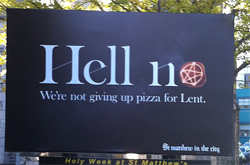
But St. Matthews Anglican church is not in the least perturbed and is displaying its own version:
Auckland Anglican church, St Matthews in the City, has put up a new billboard similar to the pizza outlets, advertising a hot cross bun with a pentagram symbol.
It says “Hell no, we’re not giving up pizza for lent”.
Priest in charge Clay Nelson says it’s about taking the mickey out of those Christians who complain about Hell Pizza’s “clever” ads.
He says people shouldn’t take things so seriously and go to war with secular society which doesn’t do Christianity any good.
If St. Matthews doesn’t take Hell seriously, what, I wonder, does it take seriously? Progressive Christianity, apparently, and the only thing it takes seriously is the act of not taking Christianity seriously.
The Anglican Communion Office is now on Twitter
Here.
Actually, it has been on Twitter for about 8 months, but I’ve only just noticed. The question is, will the ACO suffer an institutional nervous breakdown from the strain of condensing its public displays of sagacity to 140 character bursts?
Montreal parish does Lenten study on Islam
The Parish of St. Andrew and St. Mark studied Islam during Lent:
Understanding Islam:
Conversations with our Muslim Brothers and Sisters
Everyone who is interested in learning about another faith is invited to come and share in our Tuesday Lenten Series on Islam, The evening will begin with a talk given by our local Imam, Dr. Ahmad Shafaat, on the basics of the Islam faith. It will be followed by a question period, and opportunities for more conversation in small groups, with invited visitors from our local mosque.
Three Tuesdays in Lent
February 23, March 2, March 9.
7:30 PM
St Andrew and St. Mark’s Anglican Church
To make sure they had the hang of Islam, 23 parishioners attended prayers at the Dorval Mosque:

There is no word on whether the 23 Anglicans converted to Islam or not. Either way, it probably wouldn’t make much difference.
Anglican priest gets PhD in snowboarding
Anglican priest, Rev. Neil Elliot is celebrating the completion of his PhD in snowboarding, from Kingston University in London.
He discusses the minutiae of the spirituality of snowboarding here, where he observes:
One thing that came out very clearly in my research is that people in contemporary society are talking about spirituality without God and they are looking for spiritual growth and development without necessarily including God. We need to understand why that’s the case.
Understanding why people prefer spirituality to God isn’t that difficult: God makes demands of us, spirituality, in its all you need is love mushiness doesn’t.
The important thing is unity
Some interesting observations on ARCIC, the ecumenical gabfest between Anglicans and Catholics from the Catholic side here (my bold):
The trouble with ARCIC always was (as a former Catholic member of it once explained to me) that on the Catholic side of the table you have a body of men (mostly bishops) who represent a more or less coherent view, being members of a Church which has established means of knowing and declaring what it believes. On the Anglican side of the table you have a body of men (and it was only men, on both sides, in those days) the divisions between whom are just fundamental as, and sometimes a lot more fundamental than, those between any one of them and the Catholic representatives they faced: they all represented only themselves.
And they all, Catholics and Anglicans, quite simply belonged to very different kinds of institution. It isn’t just that Catholics and Anglicans believe different doctrines: it’s that there is between them a fundamental difference over their attitude to the entire doctrinal enterprise. I remember very vividly, in my days as an (Anglican) clergy member of the Chelmsford Diocesan Synod, a debate on one of the ARCIC documents followed by a vote on whether to recommend to the General Synod in London that it should be accepted. The document was accepted overwhelmingly. At lunchtime, standing at the bar with a number of clergy, I asked how they had voted; they had all voted affirmatively. I then asked them if they had read the document. None of them had; and most of them, it became clear, had little idea of what it contained. “Well”, I asked, puzzled, “why did you vote for it, then?” “The point is,” one of them replied, “the important thing is unity. The RCs are frightfully keen on doctrine. You have to encourage them: so I voted for their document”. There you have it: what the late Mgr Graham Leonard, when he was still an Anglican bishop, once called “the doctrinal levity of the Church of England”.
And there you do have it: the important thing is the illusion of unity. The same affliction assails orthodox Anglicans who remain in the Anglican Church of Canada or TEC for the sake of supposed unity – the ACA, the ACI, the Wycliffe College bunch et al.: they are actually sacrificing their principles to an illusion.
Another nail in the marriage coffin
From here:
Saskatchewan’s highest court has ruled that marriage commissioners who are public servants cannot refuse to marry same-sex couples.
The decision by the Saskatchewan Court of Appeal rejects two proposals from the provincial government that would allow some or all marriage commissioners to refuse to perform a service involving gay or lesbian partners if it offended their religious beliefs.
The government proposed that marriage commissioners who were employed before the law changed in 2004 could refuse to perform the services. It also proposed a second option where all marriage commissioners could refuse.
But the court noted that marriage commissioners are appointed by the government to perform non-religious ceremonies and are the only option for some same-sex couples seeking to tie the knot.
This decision has the unusual property of making sense and not making sense simultaneously.
It make sense because, from a secular perspective, once marriage has been redefined – and it has been – to mean just about anything you want it to mean, you cannot deny it to those who would have been outside its purview before redefinition. We shall see how long it takes for incestuous and polyamorous marriages to be accepted by the courts.
It makes no sense in the context of religion – which, after all, was the inventor of marriage – since all major religions define marriage as the union between one man and one woman. Western Anglicanism excepted, of course, but, then, it is no longer a major religion.
Anglican vicar fights to keep strip clubs and sex shops open
Rev. Paul Turp is vicar of St Leonard’s, Shoreditch, a church which was immortalised in the nursery rhyme Oranges and Lemons: “When I grow rich, say the bells of Shoreditch”.
It now has another claim to fame since Rev. Turp is supporting something that will undoubtedly start a trend in the Anglican Church: he wants to keep the local strip clubs and sex shops open – not for his own personal use, of course.
His argument is that closing them would drive the businesses underground where they would be controlled by criminals. By that standard, the borough might as well install some opium dens and brothels, too. Rev. Paul Turp could rent them space in his church making it rich – as the bells would say.